Ghost of Tsushima Review April 2026
Introduction
As of April 2026, Ghost of Tsushima is no longer just a great samurai game from a few years ago. It has become one of those modern action adventure titles people keep returning to whenever the question comes up: does this still hold up today?
The answer in April 2026 is simple: Ghost of Tsushima still holds up extremely well.
Its biggest strengths are still the same ones that made it stand out in the first place. The world is beautiful, the sword combat feels sharp and satisfying, and the overall presentation has a cinematic quality that many open world games still struggle to match. Its weaknesses are also easier to spot now that the genre has kept evolving. Some side activities become repetitive, and parts of the open world formula feel familiar rather than groundbreaking. Even so, the complete package remains polished, memorable, and very easy to recommend.
For anyone searching for a Ghost of Tsushima review in April 2026, the important thing is not whether it is the newest game on the market. It is whether it is still worth your time today. In that sense, this game has aged very well.
What Is Ghost of Tsushima About?
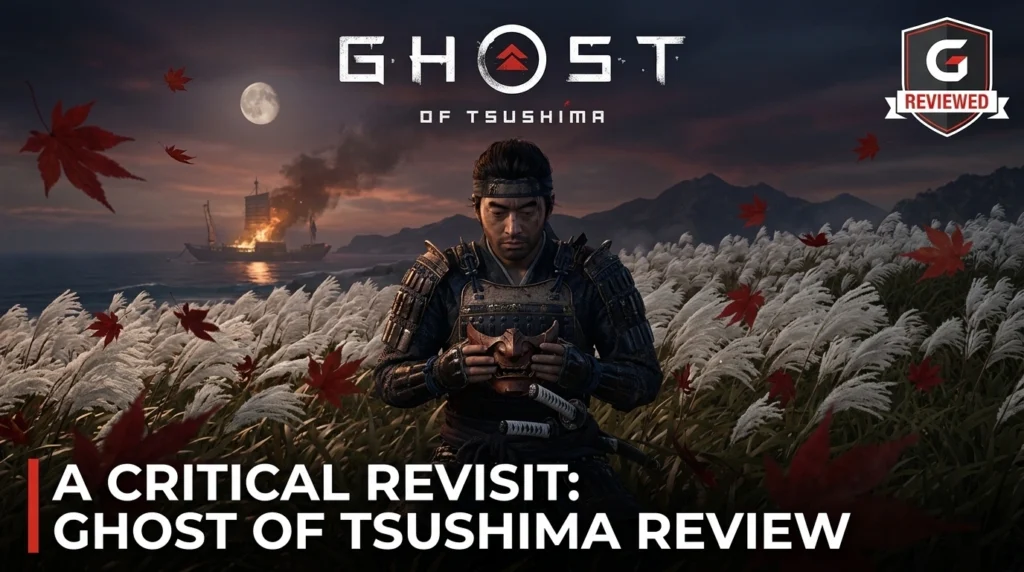
Ghost of Tsushima is an open world action adventure game from Sucker Punch Productions. The game follows Jin Sakai, a samurai trying to defend Tsushima during the Mongol invasion. Over the course of the story, he is pushed to abandon parts of the traditional samurai code and adopt more ruthless, stealth driven tactics in order to survive and protect his people.
That central idea gives the game its identity. This is not just a story about war. It is a story about transformation. Jin begins as a man shaped by discipline, duty, and tradition. As the invasion grows more brutal, he becomes something else: a warrior willing to fight in ways his old life would never have accepted.
That conflict between honor and survival is what gives Ghost of Tsushima much of its emotional weight. It is also why the game feels more focused than many open world titles. Even when you are exploring, upgrading gear, or clearing enemy camps, everything still ties back to Jin’s evolution into the Ghost.
Story and Setting
The Ghost of Tsushima story still works in April 2026 because it is built on simple but powerful themes. It is about homeland, loss, duty, identity, and the price of resistance. The narrative does not try to be overly complicated, and that helps it. The story stays clear, personal, and emotionally readable from beginning to end.
Tsushima itself is one of the game’s greatest achievements. The island is not just a map full of objectives. It feels like the emotional center of the whole experience. One moment it looks calm and poetic, filled with wind, flowers, forests, shrines, and mountain paths. The next moment it feels haunted by war, with burned villages, suffering civilians, and occupied territory. That contrast gives the world a strong atmosphere.
Even in 2026, the setting still feels special because the game treats the world with style and intention. The environment is not overloaded with clutter. It is designed to be readable, cinematic, and visually memorable. You are not just moving through content. You are moving through a place with mood.
The main plot is effective because it always gives Jin something personal to fight for. The game keeps raising the stakes without becoming messy, and that makes the overall journey satisfying.
Characters
Jin Sakai remains a strong lead because his character arc is easy to understand but never feels shallow. He is not written as a loud or overly dramatic protagonist. Instead, he is measured, serious, and burdened by what he has to become. That restraint works in the game’s favor.
One of the most important relationships in the story is between Jin and Lord Shimura. Their conflict is one of values more than personality. Shimura represents the old code, the old discipline, and the old idea of what a samurai should be. Jin increasingly represents adaptation, results, and survival at any cost. That dynamic gives the story much of its emotional tension.
Yuna is also essential. She helps pull Jin away from tradition and toward the identity of the Ghost. She is practical, wounded, and believable, and she adds a more grounded human perspective to the story.
The supporting cast in general helps the world feel fuller. Some side stories are more memorable than others, but the better character arcs add real emotional value to the game and keep the world from feeling empty.
Gameplay Overview
The easiest way to describe Ghost of Tsushima gameplay is this: it takes a familiar open world structure and elevates it through presentation, polish, and an excellent combat system.
You explore a large island, complete main story missions, clear out enemy camps, collect upgrades, unlock techniques, and take part in side activities. None of that is revolutionary by itself. What makes the game work is the way it delivers those systems. Everything feels smooth, clear, and visually satisfying.
The gameplay has two main identities. One is the honorable samurai approach, where you confront enemies directly in tense sword fights. The other is the Ghost approach, where you use stealth, tools, fear, and surprise. That dual approach gives the game variety and also supports the story in a meaningful way.
In April 2026, this gameplay loop still feels highly playable. It may not feel as fresh as it once did, but it still feels refined.
Combat System
Combat is still the biggest reason many players fall in love with Ghost of Tsushima.
Sword fights feel responsive, clean, and cinematic. Timing matters. Parrying matters. Dodging matters. The game rewards attention and rhythm rather than careless button mashing, and that gives even smaller encounters a satisfying intensity.
The stance system adds just enough tactical depth to keep battles interesting. Switching stances based on enemy type makes fights feel more active without becoming too complicated. It is not the deepest melee combat system ever made, but it hits a very smart balance between accessibility and style.
Duels deserve special praise. They are among the best moments in the game because they strip everything down to tension, movement, and precision. Even years later, those encounters still look and feel dramatic.
This is one area where the game has aged particularly well. In 2026, the combat still feels polished enough to compete with much newer action titles.
Stealth Mechanics
Stealth is not as strong as the sword combat, but it still serves the overall experience well.
Jin can hide in grass, perform assassinations, distract enemies, and use tools to thin out groups before direct combat begins. Mechanically, stealth is fairly straightforward. Enemy behavior can be predictable, and once you understand the basic patterns, the system is not especially demanding.
But stealth works because it is not just another feature. It is part of Jin’s identity shift. Every silent takedown reinforces the game’s central idea that survival may require abandoning tradition. That gives even simple stealth encounters more narrative weight.
In pure gameplay terms, stealth is solid rather than exceptional. It adds welcome variety, but it is not the reason the game stands out most.
Open World Exploration
Exploration is one of the most relaxing and immersive parts of Ghost of Tsushima.
The game’s famous wind guided navigation system still feels elegant in 2026. It is one of those design choices that sounds small until you play it. Instead of constantly staring at a heavy mini map, you are guided by the world itself. That keeps the screen cleaner and helps the world feel more natural.
The game also does a good job of pulling your attention toward points of interest without making everything feel too artificial. Birds, foxes, shrines, and environmental details gently direct exploration in ways that feel more immersive than simple checklist design.
That said, the underlying open world structure is still familiar. You are uncovering regions, liberating occupied areas, gathering upgrades, and completing activities that often fit known genre patterns. In 2026, that familiarity is easier to notice than it was at launch.
Still, the atmosphere is so strong that exploration remains enjoyable even when the structure underneath is conventional.
Side Missions and Activities
This is one of the game’s more mixed areas.
The best side missions are the character driven ones. These quests add emotional detail and make the world feel more human. They often carry stronger writing and better payoffs than the smaller activity based content.
The routine side activities are more uneven. Fox dens, bamboo strikes, shrines, haiku spots, and camp liberations are nicely presented and often visually calming, but not all of them remain exciting throughout a long playthrough. Some repetition definitely sets in.
This is probably the clearest reason why some players in 2026 may admire the game more than they love every single hour of it. The world is beautiful, but not every optional task is equally memorable.
Even so, the game deserves credit for making side content feel integrated into its mood and world rather than purely mechanical.
Progression and Skills
Progression is simple, effective, and satisfying.
As Jin grows stronger, you unlock techniques, improve equipment, and gain more options in combat and stealth. The sense of growth is steady without becoming overwhelming. Early battles can feel tense and cautious, while later encounters allow for more confidence and creativity.
The armor system also helps. Different armor sets support different playstyles, whether you want stronger direct combat, better stealth, or bonuses that improve exploration and utility. That adds a useful layer of choice without becoming a complex RPG system.
By 2026 standards, the progression system is not especially innovative, but it is clean and rewarding, which is often more important.
Graphics and Art Direction
This is one of the easiest sections to praise.
Ghost of Tsushima still looks excellent in April 2026, but more importantly, it still looks distinctive. There are games with more raw visual complexity, but fewer create such consistently striking images. Fields of flowers, golden forests, drifting leaves, misty mountain paths, moonlit duels, burning villages, and storm filled skies all give the game a strong visual signature.
The art direction is what makes it age so well. It does not depend only on technical realism. It depends on composition, color, atmosphere, and cinematic framing. That means the game still feels stylish rather than dated.
The Director’s Cut also remains the version most people will associate with the full modern experience, especially with the Iki Island expansion included on newer versions.
Soundtrack and Audio Design
The sound design continues to be one of the game’s most underrated strengths.
The music supports the emotional tone without overwhelming it. It knows when to be subtle and when to rise at the right dramatic moment. The game also uses environmental sound effectively, which adds a lot to immersion. Wind, footsteps, steel, distant battle noise, and movement through the world all help Tsushima feel physical and alive.
Combat audio is especially satisfying. Sword clashes sound sharp, and duels benefit from a strong sense of tension created through both silence and impact.
Together, the music and environmental audio help the game maintain its atmosphere even during quieter stretches.
Performance and Technical Experience
From a modern perspective, Ghost of Tsushima remains in very good shape technically.
The PS5 version has long been one of the best ways to experience the game, with strong performance and platform specific improvements. The PC version also helped broaden the game’s appeal by giving more players access to the full experience with flexible settings and smoother performance options.
That matters in April 2026 because a game’s long term value depends a lot on how easy and pleasant it is to revisit. Ghost of Tsushima still feels smooth, responsive, and polished. It feels like a finished game, and that is something players appreciate even more now.
What Works Well
What Ghost of Tsushima does best is create a complete mood.
The world, music, combat, and story all support one another. The result is a game that feels cinematic without becoming empty spectacle. When it is at its best, it makes you feel like you are inside a carefully crafted samurai film.
Combat remains a major highlight because it feels sharp and satisfying. The world remains a highlight because it is beautiful and easy to get lost in. The story remains a highlight because it gives the action emotional purpose.
It is also a very confident game. It knows exactly what experience it wants to deliver, and it delivers that experience with style.
What Could Be Better
The biggest weakness is still the familiar open world formula.
By April 2026, players have seen even more games build on this kind of structure, so Ghost of Tsushima’s repetitive side activities and checklist tendencies are easier to notice. The game often rises above them through presentation, but it does not fully escape them.
Stealth is another area that feels more good than great. It is useful and narratively meaningful, but mechanically it is not as deep or exciting as the combat system.
So while the game remains excellent, it does not feel revolutionary in every category. It feels refined rather than radical.
Is Ghost of Tsushima Worth Playing in April 2026?
Yes, absolutely.
If someone asks, “Is Ghost of Tsushima worth playing in April 2026?”, the answer is still a strong yes. The reason is simple: its best qualities are timeless enough to survive changes in trends. Great atmosphere, satisfying combat, strong art direction, and focused storytelling do not suddenly lose value because newer games exist.
It also helps that the game is still accessible across PS4, PS5, and PC, making it easy for new players to jump in depending on their platform.
For players who enjoy samurai themes, cinematic action, open world exploration, and stylish sword combat, Ghost of Tsushima remains one of the easiest recommendations you can make in 2026.
FAQS
Is Ghost of Tsushima still worth buying in April 2026?
Yes. In April 2026, Ghost of Tsushima is still worth buying because its combat, atmosphere, art direction, and story remain strong even by modern standards.
Is Ghost of Tsushima available on PC in 2026?
Yes. Ghost of Tsushima Director’s Cut is available on PC, along with PlayStation 4 and PlayStation 5.
Can you play Ghost of Tsushima on PS4 and PS5?
Yes. Ghost of Tsushima is available on both PS4 and PS5.
What version should new players choose in 2026?
Most new players should choose Director’s Cut, since it represents the expanded version of the game and includes the Iki Island content.
Is Ghost of Tsushima combat still good in 2026?
Yes. The combat still feels responsive, stylish, and satisfying, especially in duels and direct sword fights.
Does Ghost of Tsushima have repetitive side content?
Yes, some activities can become repetitive over time, although the stronger character driven side quests are much more rewarding.
Is Ghost of Tsushima a hard game?
It is not overly difficult for most players, but the combat rewards timing, patience, and learning enemy patterns.
Why does Ghost of Tsushima still rank as a good game years later?
Because its strongest qualities are not just technical. Its art direction, atmosphere, sword combat, and focused storytelling have aged well, which helps it remain relevant even in 2026.
Final Verdict
Ghost of Tsushima remains one of the strongest open world action games you can play in April 2026.
It is not perfect. Some of its side content is repetitive, some of its systems are more polished than innovative, and its stealth is not as strong as its combat. But those flaws are not enough to overshadow what the game does exceptionally well.
The world is gorgeous. The sword combat is excellent. The story has emotional weight. The presentation still feels premium. And the complete modern version of the game remains easy to recommend for anyone on PlayStation or PC.
If you missed it before, this is still a great time to play it. And if you are looking for a Ghost of Tsushima review for April 2026, the conclusion is clear: it still deserves its reputation.