How Far Apart Are Cornhole Boards? Amazing Complete Official Distance Guide 2026
If you’ve ever set up a cornhole game and found yourself asking how far apart are cornhole boards — you’re in great company. It’s one of the most commonly searched questions in the game, and getting it right actually matters. Whether you’re preparing for a competitive tournament or just want a fair and fun backyard game, this guide covers every official measurement, practical tip, and player-level adjustment you need.
The Quick Answer: Official Regulation Distance
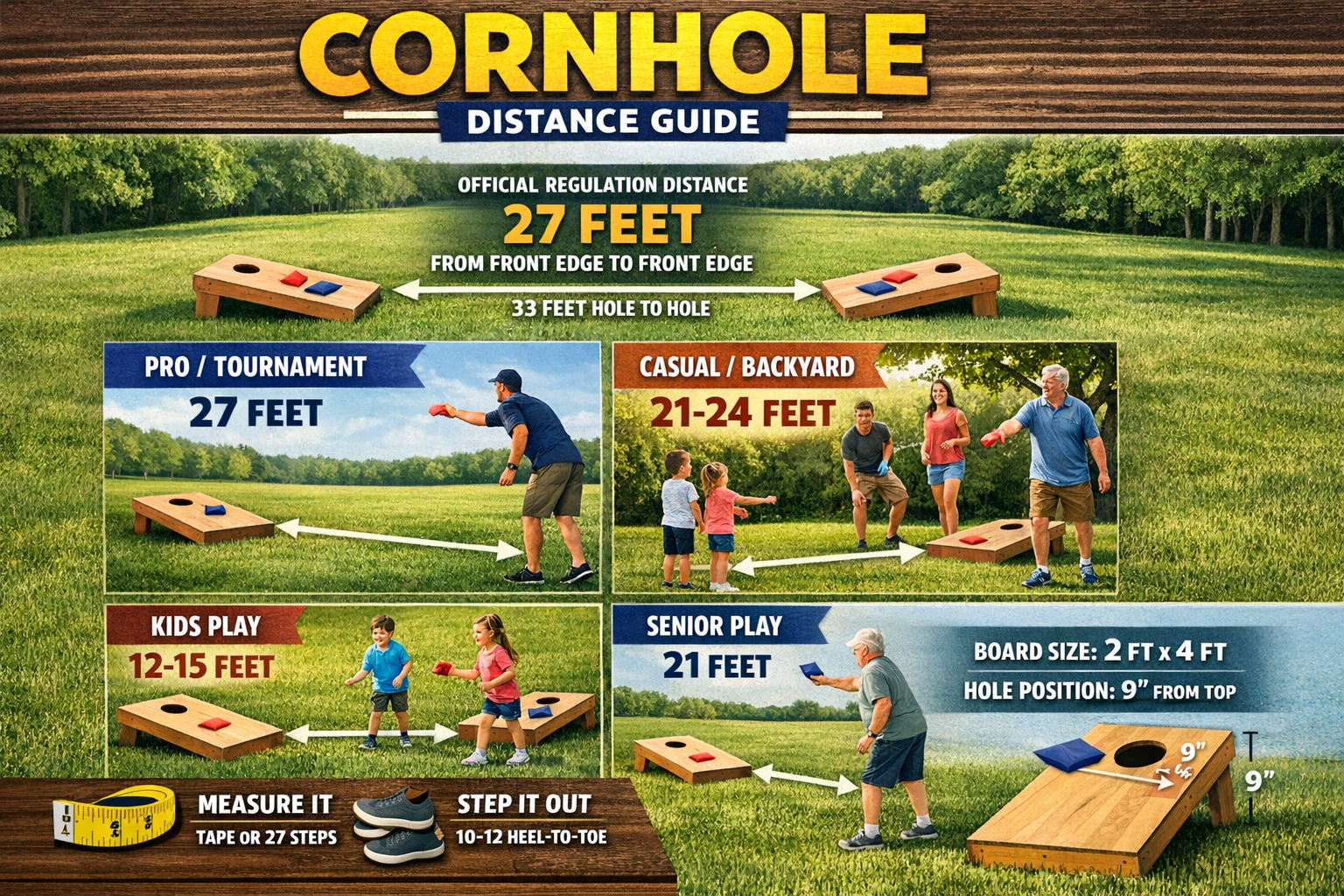
The official answer is 27 feet — measured from the front edge of one board to the front edge of the other. That is the universally accepted regulation distance used by the American Cornhole League (ACL), the American Cornhole Organization (ACO), and virtually every sanctioned competition across the United States.
Beyond that front-to-front gap, the hole-to-hole distance works out to 33 feet, since each regulation board is 4 feet long and the hole is positioned 9 inches from the top edge.
How Far Apart Should Cornhole Boards Be? (By Player Level)
One of the most important things to understand is that the “correct” answer to how far apart should cornhole boards be actually depends on who is playing. The 27-foot regulation distance is designed for adults in competitive settings. For casual players or children, shorter distances make the game more enjoyable and accessible.
Professional and Tournament Play — 27 Feet
For any adult in a competitive or official setting, 27 feet is non-negotiable. The ACL and ACO mandate this distance for all sanctioned events. So if you’re wondering how far are cornhole boards supposed to be apart in a real tournament, the answer is always exactly 27 feet, front edge to front edge.
This specific distance isn’t random. It was chosen because it creates the ideal physics for gameplay. At 27 feet, a properly thrown resin bag with a flat spin has just enough momentum to land and slide smoothly toward the hole rather than bouncing off or flying over it. The required arc — typically peaking 5 to 10 feet above the ground — produces a consistent, skill-testing toss.
Casual and Backyard Play — 21 to 24 Feet
For a tailgate, a backyard BBQ, or a family gathering, how far should cornhole boards be apart is really a matter of preference and available space. Most casual players gravitate toward 21 to 24 feet. At this range the game stays competitive without becoming frustrating for players who don’t practice regularly.
If you’re introducing friends to cornhole for the first time, 21 feet tends to be the sweet spot — close enough to build confidence, but still far enough that landing in the hole feels satisfying.
Kids and Junior Play — 12 to 15 Feet
Children under 12 generally cannot throw a weighted bag accurately at 27 feet. For younger players, setting boards 12 to 15 feet apart is the recommended approach. This distance allows kids to develop their technique and aim without the game becoming a physical challenge rather than a fun activity.
Some youth leagues use distances as short as 10 feet for very young children, and that’s perfectly reasonable — the goal is engagement, not strict adherence to adult rules.
Senior Play — 21 Feet
Many senior-friendly leagues and recreational settings use 21 feet as their standard. This preserves the competitive nature of the game while accommodating reduced throwing distance and mobility without compromising the integrity of the scoring.
What Is the Distance Between Cornhole Boards? Full Measurement Breakdown
When people ask what is the distance between cornhole boards, they’re usually asking specifically about the gap between the two boards — and that’s 27 feet. But a full regulation court involves more numbers than just that one measurement.
| Measurement | Distance |
|---|---|
| Front edge to front edge | 27 feet |
| Hole to hole | 33 feet |
| Total court length | 40 feet |
| Court width | 8 feet |
| Board size | 2 ft × 4 ft |
| Hole diameter | 6 inches |
| Hole position | 9 inches from top, centered |
| Bag size | 6 in × 6 in |
| Bag weight | 14–16 ounces |
The 40-foot total court length accounts for the boards themselves plus the pitcher’s boxes — a 4-foot-by-3-foot area on either side of each board where players must stand while throwing.
How Many Feet Between Cornhole Boards? A Step-by-Step Measurement Guide
Knowing that how many feet between cornhole boards is 27 doesn’t help unless you can measure it accurately. Here are two reliable methods to set up your court:
Method 1: The Measuring Tape (Most Accurate)
- Place your first board on flat, level ground.
- Hook a long tape measure to the front edge of the board.
- Pull the tape straight out to exactly 27 feet.
- Place the front edge of your second board at the 27-foot mark.
- Double-check that the boards are directly facing each other and not angled or skewed.
This takes about 60 seconds and guarantees accuracy. It’s the only method recommended for competitive play.
Method 2: Using Your Steps
If you don’t have a tape measure available, you can use your stride. On average, an adult walking step covers roughly 2.5 feet. To cover 27 feet, you’d need approximately 10 to 12 steps, depending on your natural stride length.
If you want even better precision without a tape, use the “foot-to-foot” method: most adult shoes are between 11 and 12 inches long. Walking 27 literal “feet” — heel to toe — will get you extremely close to the regulation distance.
So if someone asks you how many steps between cornhole boards, the practical answer is 10 to 12 average adult steps.
How Far Apart Is Cornhole Played Indoors?
How far apart is cornhole when you move the game inside? The official distance stays the same — 27 feet. The only practical concern with indoor play is ceiling height. Because a well-thrown bag follows a parabolic arc that typically peaks 5 to 10 feet above the ground, you’ll want at least 10 to 12 feet of ceiling clearance. A basement or gymnasium with a standard 9-foot ceiling can make regulation play difficult, so adjusting to 21 feet indoors is a reasonable compromise for casual settings.
How Far Are Cornhole Boards Apart? Common Setup Mistakes to Avoid
Even when you know the official distance, setup errors can still hurt the quality of your game. Here are the most common mistakes players make:
Measuring from the hole, not the front edge. This is the single most frequent error. If you measure 27 feet from the center of one hole to the center of the other, your boards end up significantly closer than regulation. Always measure from the front edge of one board to the front edge of the other.
Measuring diagonally or with a curved tape. The tape must run in a perfectly straight line between the two front edges. Any curve or diagonal throws off the measurement.
Playing on uneven terrain. If one board sits on a slope or a raised patch of ground, the effective throwing distance “feels” different even if the tape says 27 feet. Always aim for a flat, level surface for both boards.
Boards creeping during play. On grass especially, the impact of bags landing on boards can push them forward over the course of a game. Re-measure every few rounds to make sure you’re still at the correct distance.
Skewed board alignment. Both boards need to face each other directly. If one is angled even slightly, the pitcher’s boxes become unequal and the game becomes lopsided.
Understanding the Full Cornhole Court Layout
The distance between the boards is just one element of a properly set-up cornhole court. Understanding the full layout gives you a much better sense of why everything is positioned the way it is.
The pitcher’s box is a 4-foot-by-3-foot rectangle located to the side of each board. This is the area where players stand while throwing. Stepping past the front edge of the board — known as fouling — results in that bag being removed from play. In competitive matches, players take turns throwing from opposite pitcher’s boxes (one on the left side of one board, one on the right side of the other) to avoid blocking each other.
The foul line runs parallel to the front edge of each board. When people ask how far are cornhole boards apart, they’re actually asking for the distance between these two foul lines — which is where the 27-foot measurement applies.
The scoring zones are simple: a bag landing on the board scores 1 point, and a bag going through the hole scores 3 points. The game is typically played to 21 points using a “cancellation” scoring system, where both players’ scores offset each other each round.
Why the 27-Foot Distance Matters for Gameplay
The 27-foot standard wasn’t chosen arbitrarily — it exists at the intersection of physics and skill.
At 27 feet, a resin-filled bag thrown with a proper flat spin carries just enough velocity to land softly on the wooden surface and slide toward the hole. A shorter distance causes bags to hit with too much force and “kick” sideways or off the board. A longer distance would require so much arc that precise aiming becomes nearly impossible for most players.
The distance also rewards technique over raw strength. A player with good arc control and a repeatable release will consistently outperform someone who throws harder but less accurately. This balance is what makes cornhole enjoyable across skill levels — beginners can compete after a few rounds of practice, while experienced players can develop genuinely refined technique.
How Far Apart Are Cornhole Boards Supposed to Be for Different Game Types?
Here’s a consolidated overview for every situation you might encounter:
Regulation / ACL tournament: 27 feet, front to front. No exceptions.
Backyard adults (casual): 21 to 24 feet works well. Most casual players find 21 feet gives a satisfying, flowing game without the frustration of repeated short throws.
Kids under 12: 12 to 15 feet. Younger children below age 8 can go as short as 10 feet.
Seniors: 21 feet is the common recommendation in recreational senior leagues.
Indoors (low ceiling): 21 feet if the ceiling is under 10 feet high. The full 27 feet if you have at least 12 feet of clearance.
Practice and skill-building: Start at 15 feet, then gradually work up to 21 feet, then 27 feet. This progressive approach builds a repeatable throwing motion before distance becomes a challenge.
Cornhole Distance in Different Units
For international players or those who prefer metric measurements:
| Unit | Distance |
|---|---|
| Feet | 27 ft |
| Inches | 324 in |
| Meters | 8.23 m |
| Centimeters | 823 cm |
Equipment Specifications to Pair With Your Perfect Setup
Getting the distance right is only worthwhile if your equipment also meets regulation standards. Here’s what official play requires:
Boards must be 2 feet wide and 4 feet long, built from smooth wood with a slight incline. The playing surface should be sealed or painted to allow bags to slide naturally.
The hole must be exactly 6 inches in diameter and centered 9 inches from the top edge of the board and 12 inches from either side edge.
Bags must measure 6 inches by 6 inches and weigh between 14 and 16 ounces. Modern tournament bags come in two-sided versions — one side designed for grip (to stick near the hole) and one for slide (to knock opponents’ bags away or slide into the hole).
Using regulation-size boards and bags at the correct distance means your practice at home translates directly to any competitive setting you might enter.
Frequently Asked Questions
How far apart are cornhole boards in an official tournament?
Exactly 27 feet, measured from the front edge of one board to the front edge of the other. This applies to all ACL and ACO sanctioned matches.
How far should cornhole boards be apart for a backyard setup with limited space?
If 27 feet isn’t feasible, 21 feet is the most widely used casual distance. It keeps the game fun and competitive without requiring a full regulation court.
How many steps between cornhole boards if I don’t have a tape measure?
Approximately 10 to 12 average adult steps, assuming a stride of about 2.5 feet. For better accuracy, use the heel-to-toe method, as most adult shoes measure close to 12 inches.
How far apart are cornhole boards supposed to be for seniors?
Most senior recreational leagues use 21 feet. Some may go shorter depending on mobility, but 21 feet is the most common accessible standard.
What is the distance between cornhole boards measured hole to hole?
The hole-to-hole distance is 33 feet, because each board is 4 feet long and the hole sits 9 inches from the top edge.
How far apart is cornhole when playing indoors?
27 feet if ceiling height permits (at least 10 to 12 feet of clearance). Reduce to 21 feet in spaces with low ceilings.
Final Summary: The Definitive Answer
To bring it all together clearly:
How far apart are cornhole boards? 27 feet for official and adult competitive play. Measure from the front edge of one board to the front edge of the other — always.
How many steps between cornhole boards? About 10 to 12 adult walking steps, or exactly 27 heel-to-toe shoe lengths.
How far are cornhole boards supposed to be apart for kids? 12 to 15 feet is the standard junior distance.
What is the distance between cornhole boards for casual backyard games? Most players use 21 to 24 feet when playing socially.
Setting up your court correctly — with properly spaced boards, level ground, and regulation equipment — gives every player a consistent, fair experience. Whether you’re competing in a tournament or just enjoying a game in the yard, that 27-foot standard is the foundation of everything. Master the setup, and you can focus entirely on perfecting your throw.