
How to Identify If the Pashmina Shawl I Am Buying Is Genuine? Realistic Guide 2026
There is a moment every Pashmina buyer knows — standing in a market or scrolling through an online store, holding what appears to be a luxurious shawl, wondering: is this actually real? That question is not paranoia. It is wisdom. The global Pashmina market is flooded with counterfeits — synthetic blends, machine-woven imitations, and viscose fakes draped in the language of luxury. With the main keyword for this topic pulling 312,000 monthly searches in India alone, the concern is widespread, valid, and urgent.
A genuine Pashmina shawl is one of the rarest textile treasures in the world. It comes from the fine undercoat of the Changthangi goat, a rare breed native to the high-altitude plateaus of Ladakh, India, where extreme cold forces the animal to grow an incredibly fine inner fiber measuring just 12 to 16 microns in diameter — thinner than a human hair. Each shawl requires the fiber of 2 to 3 goats and months of skilled hand-spinning and hand-weaving by Kashmiri artisans. This is why a genuine piece commands a price that reflects not just fabric, but heritage, labor, and irreplaceable craftsmanship.
This guide will walk you through 10 proven identification tests, explain what to look for on labels and certifications, give you a clear price reference to spot fakes by cost alone, cover how to identify pure Pashmina when buying online, and include a dedicated Hindi section for those searching कैसे पता लगाएं कि पश्मीना शॉल असली है या नकली. By the time you finish reading, you will never be fooled again.
What Makes a Genuine Pashmina Shawl Different?
Before running any test, it helps to understand why genuine Pashmina is so distinct. Most luxury textiles can be approximated with clever synthetics — but Pashmina’s combination of extreme fineness, natural warmth, matte luster, and handwoven irregularity creates a profile that synthetics simply cannot replicate across all dimensions simultaneously. You can fake the softness. You can fake the look. But you cannot fake all of these properties together at once.
The word Pashmina itself comes from the Persian word Pashm, meaning wool — specifically the ultra-fine wool from the underbelly of the Changthangi goat. In the West, this fiber is called Cashmere, named after Kashmir where it was first processed and traded. However, not all Cashmere is Pashmina. True Pashmina uses fiber from 12 to 15 microns — significantly finer than standard Cashmere which averages 15 to 19 microns. Every genuine Pashmina is Cashmere, but not every Cashmere qualifies as Pashmina.
Authentic Kashmiri Pashmina holds Geographical Indication (GI) Certification No. 46, Certificate 97 issued by the Government of India and recognized internationally under WTO agreements. This certification guarantees that the fiber is 100% Pashm from Changthangi goats, hand-spun by artisans in Kashmir, and hand-woven using traditional methods. It is the single most powerful authentication tool available to buyers — and most fakes will never have it.
Visit for more inforamtion like How to Calculate Mulank
10 Tests to Identify If the Pashmina Shawl You Are Buying Is Genuine
1. The Touch Test — Your First and Most Instinctive Check
Pick up the shawl and hold it against your palm. Then — and this is the test most buyers skip — press it gently against your cheek. Genuine Pashmina has a warmth that builds almost immediately. It feels soft, airy, and feather-light against your skin. Not just smooth — genuinely warm and buttery in a way that synthetic fabric cannot replicate. If the shawl feels slippery, plasticky, stiff, or oddly cool to the touch, it is not real. A real Pashmina never feels scratchy or rough, no matter how tightly woven.
This test works because Pashmina fiber is hollow at the microscopic level, which traps air and creates natural insulation. Synthetic fibers are solid and transfer temperature differently. The moment the shawl touches warm skin, genuine Pashmina responds — fakes do not. Run your fingers along the fabric too: real Pashmina has a slight natural nap, a gentle organic texture. Synthetics feel artificially uniform.
2. The Burn Test — The Most Definitive Physical Test
The burn test is the gold standard for fiber identification. Take a single thread from the fringe of the shawl — never from the body, and only a tiny strand. Hold it with tweezers over a non-flammable surface and burn it with a lighter or match.
Genuine Pashmina: Burns slowly, produces a smell of burnt hair (exactly like singeing your own hair), and the residue crumbles into a fine powdery ash with no hard bead left behind. The flame self-extinguishes when removed.
Fake Pashmina (synthetic): Burns quickly, smells like burning plastic or chemicals, and leaves a hard, melted, plastic-like bead that does not crumble. Some synthetics may also produce black smoke.
| ⚠️ Safety Note: Perform the burn test only on a fringe thread, outdoors or in a well-ventilated area, on a ceramic or metal plate. Never burn the shawl body. This test is not 100% foolproof on blended fabrics — use it alongside other tests. |
3. The Ring Test — The Ultimate Fineness Proof
This is perhaps the most famous Pashmina test — and it works because of pure physics. Remove a ring from your finger (a standard finger ring works perfectly) and attempt to pass the entire folded shawl through it. A genuine, finely woven Pashmina shawl will slide through effortlessly due to the ultra-fine 12–15 micron fiber and expert handweaving technique. If the fabric bunches up, resists, or gets stuck, it is either a thicker wool blend or a synthetic fake.
The ring test is not just a party trick — it is a direct measurement of fiber fineness and weave density. Machine-woven imitations using thicker synthetic threads cannot pass through a standard ring no matter how they are folded. Experienced buyers in Kashmir markets perform this test routinely before any purchase. If a vendor refuses to let you try it or seems nervous about the test — walk away.
4. The Weave Test — Look for Beautiful Imperfection
Hold the shawl up to bright light or sunlight and examine the weave closely. Genuine handwoven Pashmina will never look machine-perfect. Look for slight irregularities — minor variations in thread spacing, small differences in tension, the occasional thicker or thinner place in the weave. These imperfections are not flaws. They are the fingerprints of the human hands that created the shawl, and they are a guarantee of authenticity.
Machine-made imitations, by contrast, look mechanically flawless — perfectly uniform jacquard patterns with no variation. That visual perfection is actually a red flag. If the weave looks too even, too regular, and too consistent across the entire shawl, it was made by a machine, not an artisan. The traditional jenny loom used by Kashmiri weavers creates small personal impressions in every piece — no two genuine shawls are identical.
5. The Warmth Test — Feel the Insulation Immediately
Drape the shawl over your shoulders or wrap it around your hands for 30 seconds. Genuine Pashmina generates warmth almost instantly due to its natural insulating properties. The hollow fiber structure of Pashm wool traps body heat with remarkable efficiency. You will feel genuinely warm — not just covered. Synthetic imitations often feel cool or neutral against the skin and take much longer to warm up, if they do at all.
This test is particularly useful when buying in a physical store where you can take a moment to wear the shawl. The warmth test combined with the touch test together create a powerful two-step verification that most fakes will fail immediately.
6. The Static Test — Rub and Watch
Take a corner of the shawl and rub it vigorously against itself or against a smooth surface. Genuine Pashmina produces minimal to no static electricity. Natural animal fibers simply do not accumulate static charge the way synthetic fibers do. Now watch what happens: if you rub a synthetic shawl, you will see tiny sparks, feel a slight electric charge, and notice that dust and small particles are attracted to the fabric. Natural Pashmina does none of this.
This test is especially useful in dry environments where static is more pronounced. Polyester and acrylic fiber — the most common materials used in fake Pashminas — are notorious for building static electricity. If the shawl you are testing crackles, sparks, or attracts lint — it is not real Pashmina.
7. The Pilling Test — Natural Fiber Tells the Truth Over Time
This test requires some time, but it tells a deeper story. Genuine Pashmina develops slight pilling — small balls of fiber forming on the surface — with regular use. This is not a defect; it is a natural characteristic of fine animal fiber. The pilling is soft and can be removed easily with a fabric comb. What is more important: the underlying fabric remains strong and intact despite the pilling.
Fake Pashmina behaves in one of two ways: either it never pills at all (a sure sign of synthetic fiber — if you have been told no pilling is a quality feature, you are looking at a fake) or it pills excessively with a hard, plastic-like quality that does not remove cleanly. Genuine pilling from real Pashmina is soft and woolly. Synthetic pilling is hard and often permanent.
8. The Shine Test — Matte Is the Mark of Authenticity
Take the shawl outside or hold it under a strong light source. Genuine Pashmina has a matte to subtly lustrous finish — never a shiny, plastic-like gloss. The natural fiber produces a soft, understated sheen that is warm and organic. It does not reflect light strongly. Synthetic materials — especially polyester and viscose — reflect light with a noticeable gloss that looks almost metallic under bright light.
This test is particularly reliable for online shopping verification once you receive a shawl. A real Pashmina photographed in sunlight will show a soft, matte surface with depth. A fake will have a noticeably shiny, flat reflective surface. Some blends (like wool-silk Pashminas) carry a subtle sheen — but this is qualitatively different from the hard synthetic gloss of a fake.
9. The Weight and Transparency Test — Light as Air
A genuine Pashmina shawl is remarkably lightweight for its size and warmth. Hold it in one hand — it should feel almost weightless. Now hold it up to a light source. You should be able to see light passing through the fabric — authentic Pashmina is woven fine enough that it is not fully opaque. This transparency combined with warmth is unique to the ultra-fine fiber.
If the shawl feels heavy and thick for its size, or appears completely opaque with no light transmission, it is likely a thick wool blend or synthetic product. The combination of lightweight + warmth + slight transparency is genuinely difficult to fake in a single product — and it is one of the strongest composite identification signals available without a laboratory test.
10. The Stretch Test — Elasticity Reveals the Fiber
Gently stretch a section of the shawl and then release it. Genuine Pashmina has natural elasticity — it returns to its original shape without remaining distorted. This spring-back quality comes from the natural crimp structure of Pashm fiber. Synthetic Pashmina either stays stretched, showing permanent distortion, or snaps back with an unnatural tightness that feels mechanical rather than organic.
This test is best performed on a section near the fringe where any stretching damage would be less visible. Apply gentle, even pressure — you are not trying to tear the fabric, just testing its memory. A shawl that recovers naturally and completely is showing you one of the hallmark properties of genuine animal fiber.
GI Certification — The Government-Backed Guarantee
If you want complete certainty without any physical testing, look for the Geographical Indication (GI) Tag. In 2019, the Government of India introduced mandatory GI certification for authentic Kashmiri Pashmina shawls. This certification — issued under GI Registration No. 46, Certificate No. 97 by the Craft Development Institute (CDI) in Srinagar — guarantees that:
| ✅ | The fiber is 100% Pashm from Changthangi goats in Ladakh |
| ✅ | The shawl was hand-spun by registered artisans in Kashmir |
| ✅ | The weaving was done by hand on traditional looms in Kashmir |
| ✅ | The seller is registered and approved by the Government of India |
| ✅ | The product meets international WTO standards for authenticity |
Each GI-certified shawl carries a rubber stamp with a unique ID attached by artisans at the Craft Development Department in Srinagar. These tags are stitched — never glued. If you see a label glued onto a Pashmina, it is fake. GI tags are also designed to be tamper-evident — they get damaged if someone tries to remove them. Future iterations of GI tags are being developed with non-removable microchips and UV-readable serial codes for even stronger verification.
Important: When buying online, always ask the seller for their GI certification number and their Handicraft Department registration. Legitimate manufacturers will provide this without hesitation. Most resellers and intermediaries who buy wholesale from Kashmir and mark up online cannot provide manufacturer registration — only business registration.
How to Read a Pashmina Label — Spot a Fake From the Tag
The label on a Pashmina tells you as much as the fabric itself — if you know how to read it. Here is exactly what to look for and what to avoid:
| ✅ Genuine Pashmina Label Says | ❌ Fake Pashmina Label Says |
| 100% Pashmina or 100% Cashmere | Pashmina Blend or Pashmina Feel |
| Made in Kashmir, India | Made in China / no origin listed |
| GI Certified — Registration No. provided | No certification mentioned |
| Handwoven / Hand-spun | Machine made or no process mentioned |
| Label is stitched onto fabric | Label is glued onto fabric |
| Fiber micron count mentioned (12–16μ) | No fiber specifications |
One of the most reliable label signals: a genuine label will always be stitched, never glued. Glue cannot hold permanently on fine Pashmina fiber — authentic sellers know this and always stitch their authentication tags. A glued tag is an instant disqualification. Similarly, if a label says “Pashmina Blend” it is telling you the truth: it is not pure Pashmina. Many buyers overlook this because the word Pashmina is still present — but a blend means synthetic or cheaper wool fibers have been added.
Real Pashmina Shawl Price — How Much Should You Pay?
Price is one of the most reliable indicators of authenticity — and one of the most misunderstood. Many buyers assume that a lower price means they found a good deal. In the Pashmina market, an unusually low price means one thing: it is not real. Here is why: producing a single genuine Pashmina shawl requires the fiber of 2–3 Changthangi goats, months of hand-spinning by skilled artisans, and weeks of hand-weaving on a traditional loom. The raw material alone costs several thousand rupees before any labor is added.
| Type | Price Range (INR) | Price Range (USD) |
| Plain Handwoven Pashmina Stole | ₹8,000 – ₹25,000 | $100 – $300 |
| Solid Colour Pashmina Shawl | ₹10,000 – ₹40,000 | $120 – $500 |
| Embroidered Pashmina Shawl | ₹25,000 – ₹1,50,000 | $300 – $1,800 |
| GI Certified Premium Shawl | ₹28,000 – ₹3,00,000+ | $350 – $3,600+ |
| ⚠️ Fake / Synthetic ‘Pashmina’ | ₹200 – ₹2,000 | $3 – $25 |
Government Price Reference: The Jammu & Kashmir Handicrafts Department and the Craft Development Institute in Srinagar periodically publish minimum price guidelines for GI-certified Pashmina to protect buyers and artisans. While market prices vary by embroidery complexity and craftsmanship, the government guidelines ensure that certified products are never sold below a minimum threshold. A plain GI-certified Pashmina stole should not be available for less than ₹8,000 at any legitimate source.
If someone is offering you a Pashmina shawl for ₹500, ₹1,000, or even ₹3,000 and calling it pure or genuine — you are looking at a synthetic blend, a wool substitute, or an outright fake. The production cost alone makes those price points impossible for authentic Pashmina. This single rule eliminates the majority of counterfeits immediately.
How to Identify Pure Pashmina Shawl When Buying Online
Online shopping for Pashmina requires extra caution because you cannot perform the touch, warmth, or ring tests before purchase. However, several verification strategies work specifically in the digital environment:
Check for GI Certification Documentation
Any legitimate online Pashmina seller should prominently display their GI Registration Number, Handicraft Department registration code, and ideally a Certificate of Authenticity in the product listing or available on request. If this information is absent from the product page and the seller cannot provide it when asked — do not buy.
Read Product Descriptions Carefully
Legitimate listings will clearly state “100% Pashmina” or “100% Cashmere” with a fiber micron count. They will specify “handwoven” and “hand-spun” with Kashmir as the origin. Vague phrases like “pashmina feel”, “pashmina blend”, “pashmina style”, or “soft as pashmina” are red flags signaling that the product is not authentic.
Examine Product Images at Zoom Level
Zoom into the product photographs and look at the weave. A genuine Pashmina will show slight irregularities in thread spacing even in high-resolution images. A perfectly uniform machine weave visible in product photos is a warning sign. Also check whether the shawl has a matte finish in photos — synthetics often appear glossy even in standard photography
Check Return Policy and Certifications
Reputable Pashmina sellers offer clear return policies and authenticity guarantees. Look for sellers who explicitly state they will refund or replace if a product fails the burn test. This willingness to back their product with a guarantee is a strong signal of legitimate sourcing. Also look for lab-backed fiber certificates which some premium sellers provide — these are scientific confirmations of fiber composition and micron count.
Verify Seller Credentials
For maximum security, buy from sellers with manufacturer registration with the Jammu & Kashmir Government Department of Handicrafts — not just business registration. This is a crucial distinction. Most online resellers purchase wholesale from Kashmir and cannot provide manufacturer registration. Sellers who are direct manufacturers with J&K Handicraft Department registration have the strongest authenticity guarantee in the market.
How to Identify an Original Kashmiri Pashmina Shawl Specifically
Not all genuine Pashmina shawls are Kashmiri Pashmina — and there is an important distinction. Nepalese Pashmina (called Chyangara Pashmina) is also authentic and GI-certified in Nepal, using similar Changthangi fiber. However, the most prized and protected designation is Kashmiri Pashmina — handwoven specifically by artisans in the Kashmir Valley using traditional jenny looms.
Original Kashmiri Pashmina shawls have several identifying characteristics beyond the standard tests:
Natural Dye Colors: Traditional Kashmiri Pashmina is dyed using natural dyes derived from fruits, vegetables, and minerals. These produce earthy, soft tones — deep burgundies, saffron yellows, indigo blues, and natural off-whites. If a shawl has extremely bright, vivid, neon-adjacent colors, it has been dyed with synthetic chemical dyes — a sign of modern industrial processing rather than traditional craftsmanship.
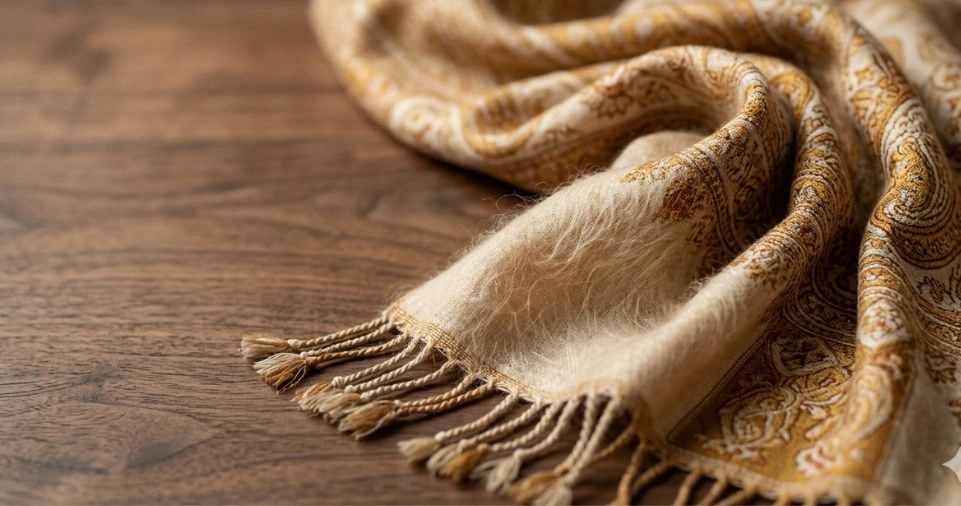
Fringe Quality: Authentic Kashmiri Pashmina has loose, natural, hand-twisted fringes directly from the loom — never cut, never braided uniformly, never machine-stitched at the edges. If the fringes are perfectly braided, cut cleanly, or sewn with machine stitching, the shawl is not an original handwoven Kashmiri piece.
Dimensions: The standard Pashmina shawl dimension is 80 × 36 inches (approximately 200 × 90 cm). A stole is typically 80 × 28 inches. If a seller offers a significantly different size at the same price point, verify the fiber composition carefully. Non-standard sizes are not automatically fake, but they warrant additional scrutiny.
Temperature Responsiveness: One of the most remarkable properties of genuine Kashmiri Pashmina is its ability to adapt to body temperature. Drape it over your shoulders and within seconds it adjusts — warming you without trapping excessive heat. This thermoregulation is a property of Pashm fiber’s hollow structure and cannot be replicated by synthetic materials.
कैसे पता लगाएं कि पश्मीना शॉल असली है या नकली? (Hindi Guide)
| यह सेक्शन उन लोगों के लिए है जो हिंदी में सर्च करते हैं: ‘कैसे पता लगाएं कि पश्मीना शॉल असली है या नकली’, ‘असली पश्मीना कैसे पहचानें’, ‘नकली पश्मीना की पहचान’ |
असली पश्मीना शॉल की पहचान करने के 5 सबसे आसान तरीके:
1. जलाने का परीक्षण (Burn Test): शॉल के किनारे से एक धागा लें और उसे जलाएं। असली पश्मीना जलने पर बालों जैसी गंध देता है और राख में बदल जाता है। नकली पश्मीना जलने पर प्लास्टिक जैसी गंध देता है और पिघलकर कड़ा बीड बनाता है।
2. अंगूठी परीक्षण (Ring Test): असली पश्मीना शॉल इतनी बारीक होती है कि वह एक अंगूठी में से आसानी से निकल जाती है। नकली शॉल अटक जाएगी।
3. स्पर्श परीक्षण (Touch Test): असली पश्मीना को गाल से लगाएं — यह मुलायम, गर्म और पंख जैसी हल्की होती है। नकली शॉल चिकनी या प्लास्टिक जैसी लगती है।
4. चमक परीक्षण (Shine Test): असली पश्मीना में मैट फिनिश होती है — यह चमकदार नहीं होती। अगर शॉल रोशनी में ज़्यादा चमके, तो वह नकली है।
5. GI सर्टिफिकेट (GI Certification): सबसे पक्का तरीका है कि शॉल पर GI टैग हो जो सिला हुआ हो (चिपकाया नहीं)। यह भारत सरकार द्वारा जारी Geographical Indication प्रमाणपत्र है।
असली पश्मीना की कीमत: असली पश्मीना शॉल की कीमत ₹8,000 से ₹3,00,000 तक होती है। अगर कोई ₹500–₹2,000 में ‘असली पश्मीना’ बेच रहा है, तो वह निश्चित रूप से नकली है।
कश्मीर में असली पश्मीना शॉल की कीमत: कश्मीर में सीधे बुनकरों से खरीदने पर एक सादी पश्मीना स्टोल ₹6,000–₹15,000 में मिल सकती है। कढ़ाई वाली शॉल ₹25,000 से शुरू होती है।
How to Buy Genuine Pashmina — A Smart Buyer’s Checklist
Armed with all the knowledge above, here is a practical checklist to follow every time you consider purchasing a Pashmina shawl — whether in a physical store or online:
| # | Buyer’s Checklist Item |
| 1 | Ask for GI Certification number or Handicraft Department registration |
| 2 | Confirm label is stitched — not glued |
| 3 | Check label says 100% Pashmina or 100% Cashmere — not ‘blend’ or ‘feel’ |
| 4 | Verify price is above ₹8,000 for a stole and ₹10,000+ for a full shawl |
| 5 | Perform the touch test — press against your cheek, feel warmth immediately |
| 6 | Perform the ring test — the shawl should pass through a standard ring |
| 7 | Examine the weave — look for natural slight irregularities, not machine-perfect patterns |
| 8 | Check for matte finish — no plastic shine or reflective gloss |
| 9 | Confirm fringes are hand-twisted and natural, not braided or machine-cut |
| 10 | For online purchases, verify seller has manufacturer registration — not just reseller status |
FAQs — How to Identify If the Pashmina Shawl I Am Buying Is Genuine
Q: What is the easiest way to identify a genuine Pashmina shawl?
A: The easiest combination of tests is the touch test + ring test. Press the shawl against your cheek — it should feel immediately warm, soft, and feather-light. Then try passing the folded shawl through a standard finger ring. A genuine Pashmina passes effortlessly. For definitive confirmation, add the burn test: a fringe thread should smell like burnt hair and turn to powdery ash, not melt like plastic.
Q: What is the government certified price of Pashmina shawl?
A: The Jammu & Kashmir Handicrafts Department guidelines set the minimum price for GI-certified Pashmina. A genuine plain Pashmina stole starts at ₹8,000, a solid shawl at ₹10,000, and embroidered pieces start from ₹25,000. Any Pashmina sold below ₹8,000 claiming to be genuine is almost certainly not authentic.
Q: How can I identify a fake Pashmina label?
A: A fake Pashmina label is typically glued onto the fabric (not stitched), uses vague terms like “Pashmina Blend” or “Pashmina Feel”, has no GI certification number, does not mention Kashmir as origin, and provides no fiber composition or micron count. A genuine label is stitched, clearly states 100% Pashmina or Cashmere, and includes GI certification details.
Q: What is the price of pure Pashmina shawl in Kashmir?
A: Buying directly from Kashmir weavers or government-registered manufacturers, a plain pure Pashmina stole ranges from ₹6,000 to ₹20,000. A plain shawl starts at ₹10,000 to ₹35,000. Sozni embroidered Pashmina shawls start from ₹28,000 and premium pieces can go up to ₹3,00,000 or more. These prices reflect the raw material cost, artisan labor, and authenticity guarantee.
Q: Is all Cashmere the same as Pashmina?
A: No. Pashmina uses ultra-fine fiber from 12 to 15 microns exclusively from Changthangi goats in Ladakh. Standard Cashmere averages 15 to 19 microns from various global sources. Every genuine Pashmina is technically Cashmere, but not all Cashmere qualifies as Pashmina. Kashmiri Pashmina is handwoven — standard Cashmere products are often machine-made. Pashmina is consistently softer, warmer, and more expensive than regular Cashmere.
Q: Can you identify genuine Pashmina when buying online?
A: Yes — check for GI certification documentation, verify the seller has J&K Handicraft Department manufacturer registration (not just business registration), confirm the label says 100% Pashmina with Kashmir origin, look for matte finish and slight weave irregularities in product photos, check price against the reference table above, and read return policy — legitimate sellers offer authenticity guarantees.
Q: कैसे पता लगाएं कि पश्मीना शॉल असली है या नकली?
A: असली पश्मीना की पहचान के लिए: (1) जलाने पर बालों जैसी गंध आए, (2) अंगूठी से निकल जाए, (3) गाल पर गर्म और मुलायम लगे, (4) मैट फिनिश हो — चमकदार न हो, (5) GI टैग सिला हुआ हो और (6) कीमत ₹8,000 से कम न हो. अगर इनमें से कोई भी बात गलत है, तो शॉल नकली है।
Q: Does genuine Pashmina pill?
A: Yes — and this is normal. Genuine Pashmina develops slight soft pilling with regular use, which is a natural characteristic of fine animal fiber. The pilling is soft and easily removed with a fabric comb. If a seller claims their Pashmina never pills, they are either selling a synthetic product or describing machine-processed fiber. A Pashmina that never pills at all is almost certainly not pure natural fiber.
Final Thoughts
Owning a genuine Pashmina shawl is not just a fashion choice — it is an investment in Kashmiri heritage, artisan livelihoods, and a centuries-old craft that has survived Mughal courts, colonial trade routes, and now a global counterfeit market. Every time a buyer pays for authentic Pashmina, they are directly supporting the hand-spinners and weavers of Kashmir who keep this extraordinary tradition alive.
The 10 tests in this guide — combined with a basic understanding of GI certification, label verification, and realistic pricing — give you everything you need to make confident, informed decisions whether you are buying in a Srinagar market, a Delhi boutique, or an online store. The fake market survives because buyers do not know what to look for. Now you do.
Use the knowledge. Buy real. Support the craft. A genuine Pashmina will last a lifetime — and so will the satisfaction of knowing exactly what you are holding.