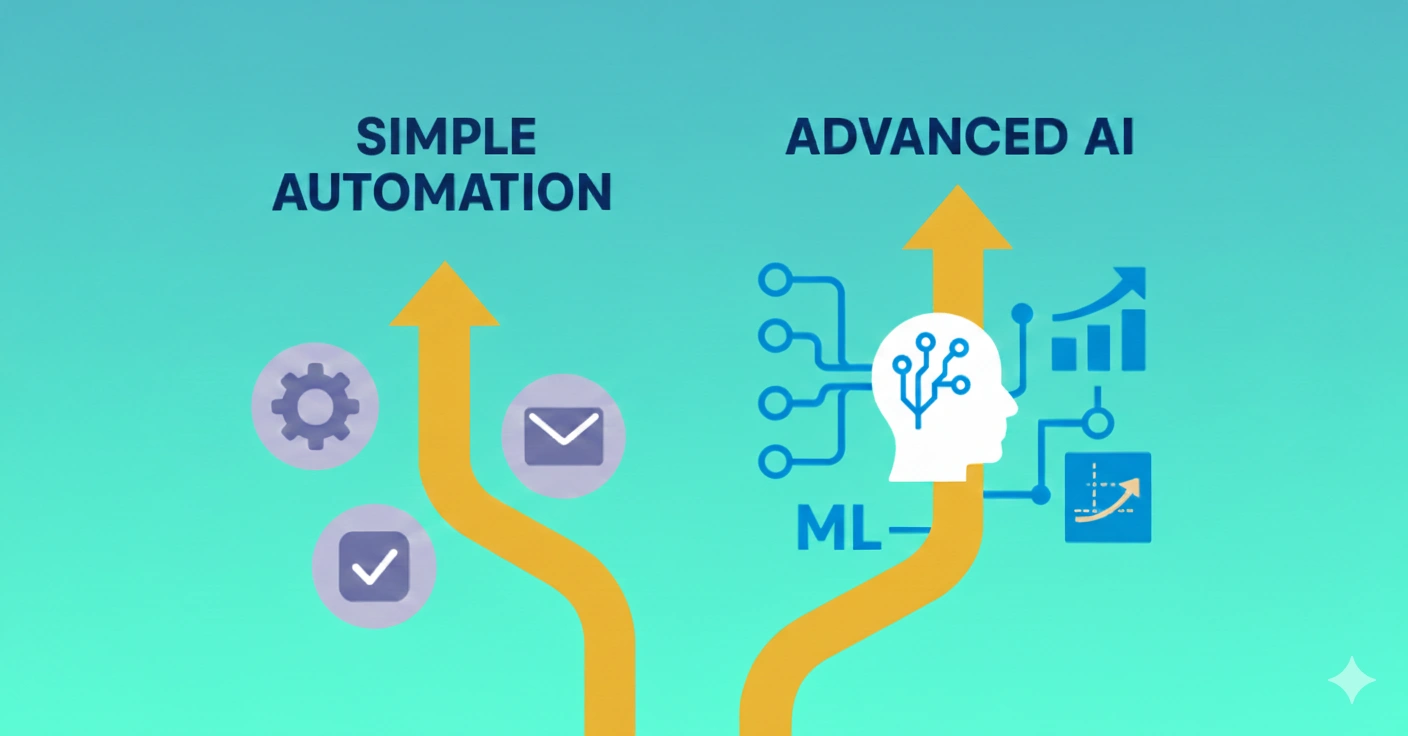
Should I Start with Simple Automation or Advanced AI? (Beginner’s Decision Guide)
You know you need to automate something in your business. Your inbox is overflowing, your team is drowning in repetitive tasks, and you’re losing customers because you can’t respond fast enough.
But you’re stuck on one critical decision:
Should you start with simple, basic automation—or jump straight to advanced AI?
On one side, influencers and tech publications make it sound like you need sophisticated artificial intelligence with machine learning capabilities or you’ll fall behind. On the other, your budget and common sense suggest starting small might be smarter.
Here’s the truth that will save you thousands of dollars and months of frustration: For 87% of small to medium businesses, simple automation is not only sufficient—it’s superior to complex AI for getting started.
According to McKinsey research, businesses that start with straightforward automation and scale gradually see 40% faster ROI and 60% lower implementation failure rates compared to those jumping into complex AI solutions prematurely.
This article will help you make the right choice for your specific situation—not based on hype, but on practical business logic.
Understanding the Difference: Simple vs. Advanced
First, let’s clarify what we’re actually comparing.
Simple Automation (Rules-Based Systems)
What it is: Software that follows predetermined “if-then” rules you set up.
How it works:
- IF customer asks about hours → THEN show this response
- IF form submitted → THEN send to sales team
- IF email contains “refund” → THEN create priority ticket
Think of it like: A sophisticated vending machine. You press specific buttons, you get predictable results. No learning, no adaptation, just reliable execution of programmed instructions.
Technical name: Rule-based automation, workflow automation, scripted responses
Examples:
- Email autoresponders
- Chatbots with predetermined conversation flows
- Automated appointment reminders
- Contact form routing
- Canned response systems
Advanced AI (Machine Learning Systems)
What it is: Software that learns from data and improves over time without explicit programming for every scenario.
How it works:
- Analyzes thousands of past conversations
- Identifies patterns in how questions are phrased
- Predicts customer intent even with unexpected wording
- Adapts responses based on what works
- Gets smarter with more interactions
Think of it like: A human employee who gets better at their job over time by learning from experience rather than just following a manual.
Technical name: Natural Language Processing (NLP), Machine Learning, Conversational AI
Examples:
- GPT-powered chatbots
- Sentiment analysis systems
- Predictive customer service
- AI-generated personalized responses
- Voice assistants understanding context
Side-by-Side Comparison: What You Actually Get
| Feature | Simple Automation | Advanced AI |
| Setup time | 2-10 hours | 20-200+ hours |
| Upfront cost | $0-500 | $2,000-50,000+ |
| Monthly cost | $0-300 | $300-5,000+ |
| Technical skill needed | Basic (like using PowerPoint) | Moderate to Advanced |
| Accuracy out of the box | 90-95% (within programmed scenarios) | 60-80% (requires training) |
| Handles unexpected questions | Poorly (only knows what you taught it) | Well (learns patterns and context) |
| Improvement over time | Manual updates only | Automatic learning (with supervision) |
| Transparency | 100% (you know exactly what it will say) | Variable (sometimes unpredictable) |
| Regulatory compliance | Easy to control | Requires careful oversight |
| Best for | Predictable, repetitive tasks | Complex, nuanced interactions |
| ROI timeline | 1-3 months | 6-18 months |
When Simple Automation Is the Right Choice (90% of Beginners)
Most businesses starting their automation journey should begin with simple, rule-based systems. Here’s when that’s definitely you:
Your Situation Matches These Criteria
✓ Predictable question patterns
- 70%+ of your customer inquiries are variations of 20-30 common questions
- “What are your hours?” “How much does it cost?” “How do I track my order?”
✓ Clear business processes
- Your workflows follow consistent steps
- You can map out exactly what should happen in each scenario
- Little need for interpretation or judgment calls
✓ Limited automation budget
- Under $5,000 for initial implementation
- Under $500/month for ongoing costs
- Need to prove ROI before bigger investment
✓ Non-technical team
- You or your team will manage the system
- No developers on staff
- DIY implementation is important
✓ Immediate ROI pressure
- Need to show results within 90 days
- Can’t afford lengthy implementation projects
- Boss/investors want quick wins
Real Success Story: Simple Automation Wins
Business: Local veterinary clinic with 3 vets, 8 staff members
Challenge:
- 150+ daily calls about hours, pricing, appointment availability
- Staff spending 12 hours daily answering same questions
- Missed calls resulting in lost appointments
Considered: Advanced AI system quoted at $15,000 implementation + $800/month
Actually chose: Simple Tidio chatbot with predetermined FAQ responses
Implementation:
- Time: One weekend (8 hours total)
- Cost: $29/month
- Setup: Created 25 FAQ responses covering common questions
- Complexity: Drag-and-drop conversation builder
Results after 60 days:
- 73% of routine questions handled automatically
- Phone call volume reduced by half
- Staff redeployed to patient care
- Appointment bookings increased 18%
- Cost saved: $1,200 monthly in staff time
- ROI: 4,038% in first year
Why simple won: “We just needed to answer the same 25 questions over and over. AI that ‘learns’ would have been total overkill. Simple automation solved exactly what we needed for 2% of the cost.”
When Advanced AI Makes Sense (10% of Cases)
Advanced AI automation IS worth the investment when:
Complex, Unpredictable Interactions
You need AI if:
- Questions are highly variable with unlimited phrasing possibilities
- Context matters significantly (same words mean different things in different situations)
- Nuanced understanding required (sarcasm, idioms, cultural references)
Example: Mental health support chatbot needs to understand emotional nuance and context—simple rules won’t cut it.
Large-Scale Operations with Data
You need AI if:
- Processing 10,000+ customer interactions monthly
- Have historical data from past conversations to train AI
- Need to handle multiple languages naturally
- Personalization at scale is crucial
Example: International e-commerce site with millions of product SKUs and customers in 50 countries.
Competitive Differentiation
You need AI if:
- Customer experience sophistication is your main competitive advantage
- Competitors have advanced systems you need to match
- Premium pricing justified by superior technology
Example: Luxury brand where cutting-edge customer service technology enhances brand perception.
Specific AI-Only Capabilities Required
You need AI if:
- Sentiment analysis to detect frustrated customers
- Predictive routing (this customer type needs this kind of agent)
- Voice recognition and natural speech processing
- Image recognition for visual customer service
Example: Insurance company analyzing claim photos to pre-assess damage.
The Cost Reality Check
Let’s look at real numbers for typical small business implementations:
Simple Automation Budget
| Expense | Year One | Ongoing Annual |
| Platform subscription | $0-360 | $0-3,600 |
| Setup time (DIY) | $500-1,500 (your time) | $0 |
| Professional setup (optional) | $0-2,000 | $0 |
| Monthly maintenance | $50-200 | $600-2,400 |
| Training/support | $0-500 | $0-300 |
| Total Year One | $550-4,560 | $600-6,300 |
Break-even: Typically 2-4 months based on time saved
Advanced AI Budget
| Expense | Year One | Ongoing Annual |
| Platform subscription | $3,600-60,000 | $3,600-60,000 |
| Implementation/consulting | $5,000-50,000 | $0 |
| AI training and tuning | $2,000-20,000 | $2,000-10,000 |
| Integration development | $3,000-30,000 | $1,000-5,000 |
| Ongoing optimization | $2,400-18,000 | $2,400-24,000 |
| Training/support | $1,000-5,000 | $1,000-5,000 |
| Total Year One | $17,000-183,000 | $10,000-104,000 |
Break-even: Typically 12-24 months based on efficiency gains
Reality check: Advanced AI costs 37-40x more in year one for most small businesses.
Decision Framework: Your Personal Automation Roadmap
Take This 5-Minute Assessment
Score each question: Yes (1 point) or No (0 points)
Section A: Complexity Assessment
- Do customers ask questions in highly varied, unpredictable ways? ___
- Do you need to understand context across multiple interactions? ___
- Do responses require nuanced judgment rather than fixed answers? ___
- Do you handle inquiries in 3+ languages regularly? ___
- Is every customer interaction unique and unrepeatable? ___
Section B: Scale Assessment
6. Do you process 5,000+ customer interactions monthly?
7. Do you have 6+ months of historical conversation data?
8. Will you surpass 100,000 interactions annually within 2 years?
9. Do you serve customers across 10+ countries?
10. Do you need to personalize based on extensive customer data?
Section C: Resource Assessment
11. Can you invest $15,000+ upfront in automation?
12. Do you have technical team members or developers?
13. Can you wait 6-12 months for positive ROI?
14. Do you have dedicated team for ongoing AI optimization?
15. Is technology innovation central to your brand?
Scoring:
0-3 points: Start with simple automation (87% probability this is right for you)
4-7 points: Start simple, plan for AI upgrade in 12-18 months as you grow
8-11 points: Consider advanced AI but still prototype with simple version first
12-15 points: Advanced AI is justified for your use case
The Crawl-Walk-Run Approach (Recommended)
Rather than all-or-nothing, most successful businesses follow a phased approach:
Phase 1: Crawl (Months 1-3)
Start with: Simple automation handling your top 10-15 FAQs
Investment: $0-500
Goal: Prove automation works, learn customer behavior, build confidence
Success metric: 50-60% of routine questions automated
Platform examples: Tawk.to (free), Tidio (free-$29), ManyChat (free)
Phase 2: Walk (Months 4-9)
Expand to: 30-40 FAQ responses, basic personalization, integration with email/CRM
Investment: $300-2,000 additional
Goal: Handle 70-80% of routine inquiries, optimize based on data
Success metric: Measurable ROI, positive customer feedback
Platform examples: Tidio Professional, Intercom Starter, HubSpot
Phase 3: Run (Months 10+)
Consider upgrading to: Advanced AI if data shows need for:
- Better handling of question variations
- Multilingual capabilities
- Predictive features
- Voice interactions
Investment: $5,000-20,000 additional
Goal: Achieve 85-90% automation rate with sophisticated understanding
Success metric: AI demonstrably outperforms simple rules
Platform examples: Intercom with AI, Drift, Custom AI integration
Real-World Comparison: Same Business, Different Choices
Company A: Jumped Straight to Advanced AI
Business: Online education platform, 200 daily inquiries
Choice: Implemented enterprise AI solution immediately
Investment:
- Upfront: $28,000
- Monthly: $1,200
- Setup time: 4 months
Results after 12 months:
- Automation rate: 78%
- Customer satisfaction: 4.1/5
- ROI: Breaking even in month 14
- Ongoing optimization: 10 hours monthly required
Outcome: Successful but expensive and slow
Company B: Started Simple, Scaled Smart
Business: Online education platform (similar size and needs as Company A)
Choice: Started with simple Tidio chatbot
Investment:
- Month 1-6: $174 total (Tidio Professional)
- Setup time: 2 weekends
- Results: 68% automation rate, 4.3/5 satisfaction
Then: After proving ROI, upgraded to AI features selectively
Investment Month 7-12:
- Additional $3,000 for AI-enhanced platform
- Added natural language processing for question variations
Results after 12 months:
- Automation rate: 82%
- Customer satisfaction: 4.4/5
- Total invested: $3,174 (vs. $42,400 for Company A)
- ROI: Positive since month 3
- Savings: $39,226 with nearly identical results
Lesson: “Starting simple let us learn what we actually needed. The AI features we eventually added were strategic choices based on data, not guesses.”
Common Beginner Mistakes
Mistake 1: Overbuying Based on Future Needs
Wrong thinking: “We’ll eventually need AI, so let’s buy it now”
Why it fails: You’re paying for capabilities you won’t use for years
Right approach: Buy for today’s needs, upgrade when data proves necessity
Mistake 2: Choosing AI to Look Sophisticated
Wrong thinking: “Advanced AI makes us look cutting-edge”
Why it fails: Customers care about results, not technology
Right approach: Impress with speed and accuracy, regardless of underlying technology
Mistake 3: Assuming Simple = Inferior
Wrong thinking: “If it’s easy and cheap, it can’t be good”
Why it fails: Simple automation is extremely effective for routine tasks
Right approach: Use the right tool for the job—sophistication doesn’t equal effectiveness
Mistake 4: Not Starting at All
Wrong thinking: “I’ll wait until I can afford the best AI solution”
Why it fails: Waiting costs you money daily in inefficiency
Right approach: Start with free tools TODAY, upgrade incrementally
Your Personal Action Plan
This Week: Assessment Phase
Day 1: Document your current reality
- How many customer inquiries do you receive daily?
- What are the 20 most common questions?
- How much staff time is spent answering these?
Day 2: Calculate opportunity cost
- Hours spent on repetitive answers × hourly wage = monthly cost
- This number becomes your automation budget ceiling
Day 3: Take the decision framework quiz
- Complete the 15-question assessment above
- Be honest about current needs (not future dreams)
Day 4: Research simple automation platforms
- Try free tiers of Tawk.to, Tidio, ManyChat
- Watch 3-4 tutorial videos for each
- Test their interfaces
Day 5: Make your decision
- If score was 0-7: Choose simple automation platform
- If score was 8+: Get quotes from AI consultants
Next 2 Weeks: Implementation
Week 1:
- Set up account on chosen platform
- Build first 10 FAQ responses
- Customize appearance to match brand
- Test thoroughly
Week 2:
- Add 10-20 more FAQs
- Set up lead capture
- Install on website
- Go live with monitoring
First 3 Months: Optimize and Learn
Monthly reviews:
- What questions are customers asking that bot can’t answer?
- What’s the automation rate?
- What’s customer satisfaction?
- Where are conversation breakdowns happening?
Decision point at Month 3:
- If simple automation handles 70%+ of queries → Continue optimizing
- If struggling with question variations → Consider AI upgrade
- If hitting platform limitations → Explore advanced tier
The Simple Truth About Starting
Here’s what nobody tells you about the simple vs. advanced AI decision:
The businesses that succeed with automation aren’t the ones who start with the most sophisticated technology.
They’re the ones who:
- Start quickly with something manageable
- Learn from real customer interactions
- Iterate based on data
- Upgrade strategically when justified
Think of it like fitness:
Simple automation = Walking daily for 30 minutes
- Low barrier to entry
- Immediate health benefits
- Sustainable long-term
- Affordable for everyone
Advanced AI = Training for Ironman triathlon
- Requires significant preparation
- Expensive equipment and coaching
- Lengthy commitment
- Reserved for specific goals
Question: Do you need to complete an Ironman to get healthy? No. Will daily walks transform your health? Absolutely.
Same principle applies to automation.
Technical Comparison Table
| Aspect | Simple Automation | Advanced AI |
| Question understanding | Exact match or close variations | Understands intent despite varying phrasing |
| Context retention | Limited (within single conversation flow) | Advanced (across multiple interactions) |
| Learning capability | None (static until you update) | Continuous (improves from interactions) |
| Language support | Manual translation required | Natural multi-language processing |
| Sentiment detection | Keyword-based only | Nuanced emotional understanding |
| Custom training | Not applicable | Requires data sets and tuning |
| Predictability | 100% (always same response) | Variable (generates contextual responses) |
| Error rate | Low within programmed scenarios | Higher initially, improves over time |
Industry-Specific Recommendations
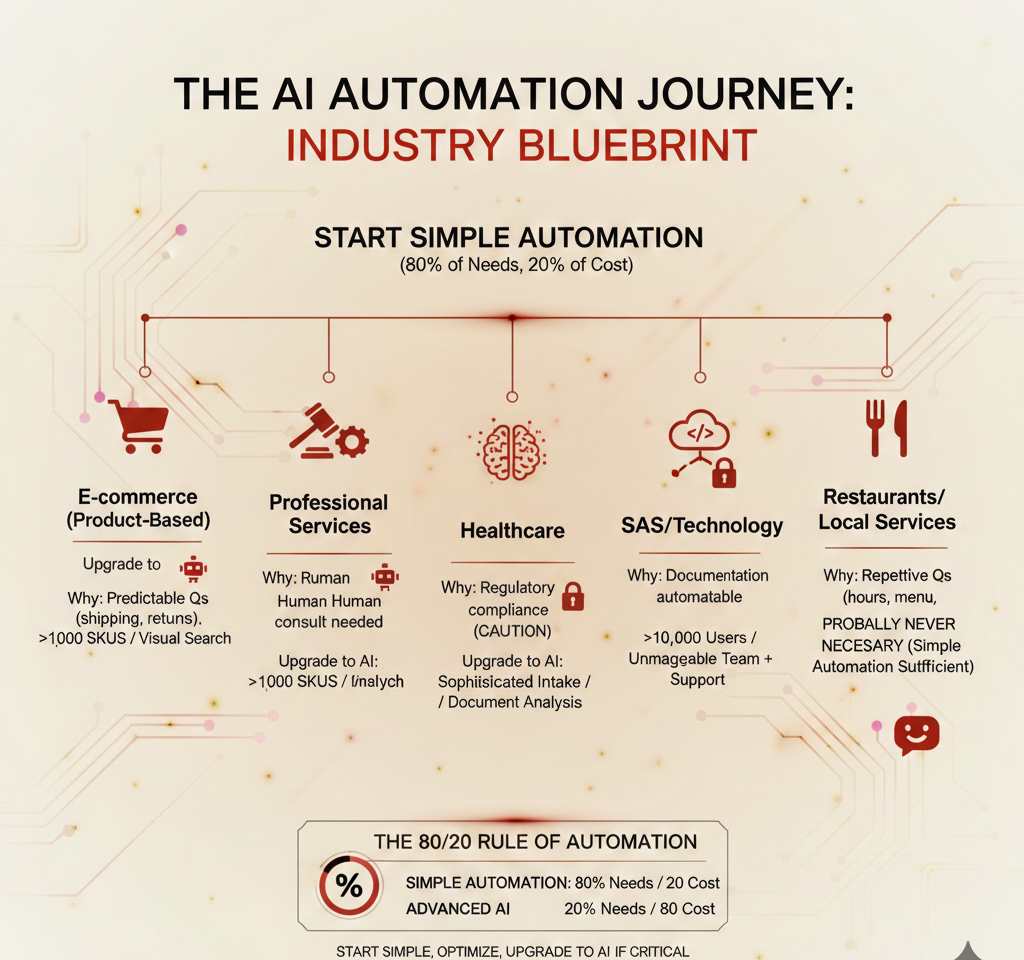
E-commerce (Product-Based)
Start with: Simple automation
Why: Most questions are predictable (shipping, returns, sizing)
Upgrade to AI when: Catalog exceeds 1,000 SKUs or need visual search
Professional Services (Consulting, Legal, Accounting)
Start with: Simple automation for scheduling and basic info
Why: Many inquiries require human consultation anyway
Upgrade to AI when: Need sophisticated intake questionnaires or document analysis
Healthcare
Start with: Simple automation with EXTREME caution
Why: Regulatory compliance easier with controlled responses
Upgrade to AI when: Have compliance team and can monitor carefully
SaaS/Technology
Start with: Simple automation for common technical questions
Why: Documentation can be automated, but complex troubleshooting needs humans
Upgrade to AI when: User base exceeds 10,000 or support volume unmanageable
Restaurants/Local Services
Start with: Simple automation
Why: Questions are highly repetitive (hours, menu, reservations)
Upgrade to AI: Probably never necessary (simple automation sufficient indefinitely)
The 80/20 Rule of Automation
Here’s the insight that will save you thousands:
Simple automation handles 80% of what you need for 20% of the cost.
Advanced AI handles that remaining 20% for 80% of the cost.
For most businesses, the math is obvious: Start simple, optimize that 80%, and only invest in AI if the remaining 20% becomes critical to your business.
Conclusion: The Paralysis-Proof Decision
Should you start with simple automation or advanced AI?
For 87% of readers: Start with simple automation TODAY.
Here’s why this is the right answer:
1. Lower risk: $0-500 initial investment vs. $15,000-50,000
2. Faster results: Live in days/weeks vs. months
3. Easier management: No technical expertise needed
4. Provable ROI: See results immediately, justify upgrades later
5. Lower regret: If it doesn’t work, you’ve lost $50, not $50,000
The perfect is the enemy of the good. Don’t let dreams of sophisticated AI prevent you from implementing simple automation that solves 80% of your problems today.
Your Next Step (Choose One)
If you scored 0-7 on the assessment:
Action: Create a free account on Tawk.to or Tidio THIS WEEK. Spend Saturday building your first 10 FAQ responses. Go live on Monday.
If you scored 8-11:
Action: Start with simple automation NOW to learn. Schedule a conversation with AI vendors for 6 months from now. Use the data you collect to make an informed upgrade decision.
If you scored 12-15:
Action: Get quotes from 3 AI consultants. BUT also implement simple automation immediately while AI is being built. You’ll learn invaluable lessons that inform your AI requirements.
Remember: The best automation system is the one you actually implement.
Simple automation implemented beats advanced AI delayed every single time.
Stop researching. Stop overthinking. Start automating.
Your customers are waiting for instant answers. Simple automation can provide them today. Advanced AI can wait until tomorrow—if you even need it at all.
Additional Resources: