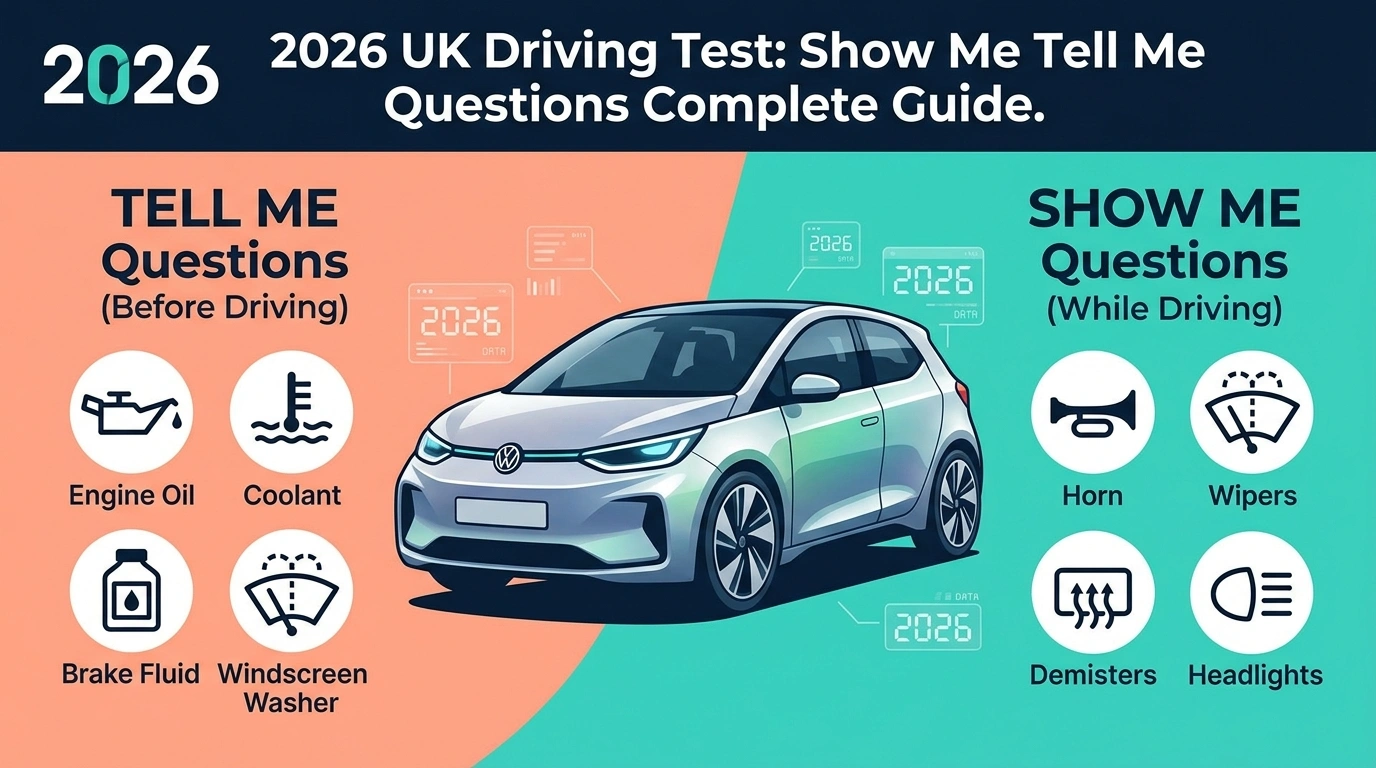
Show Me Tell Me Questions: The Complete 2026 Guide to UK Driving Test Vehicle Safety Questions
What Are Show Me Tell Me Questions? (Definition & Meaning)
“Show Me Tell Me” questions are the official vehicle safety questions set by the Driver and Vehicle Standards Agency (DVSA) that form part of every UK practical driving test. They assess whether a learner driver understands how to carry out basic vehicle checks and operate essential car controls safely — before and during a live road test.
The name describes exactly what happens:
- “Tell Me” — you explain verbally how you would carry out a vehicle safety task (asked before you drive)
- “Show Me” — you physically demonstrate a safety task while the car is moving (asked during the drive)
Key Fact: There are 7 Show Me questions and 14 Tell Me questions in the official DVSA bank. Your examiner will ask you one of each during your test — two questions in total.
When Were Show Me Tell Me Questions Introduced?
Show Me Tell Me questions have existed since the early 2000s, but the format changed significantly in December 2017. Before the change, both questions were asked at the start of the test while the car was stationary. The DVSA updated the format so that:
- The Tell Me question remains at the start, before driving begins
- The Show Me question is now asked while driving on the road
This change made the test more realistic. The 2026 questions are identical to those introduced in December 2017 — the list has not changed since.
Why Do Show Me Tell Me Questions Matter?
Many learner drivers underestimate this section. Here is why these questions genuinely matter:
- Scoring: Getting one or both questions wrong earns you one driving fault (minor). You need 15 minors to fail, so this alone will not fail you.
- Serious fault risk: If your Show Me demonstration involves dangerous driving — drifting out of lane, taking eyes off the road — you can receive a serious or dangerous fault and fail immediately.
- Real-world safety: Understanding how to check oil, tyre pressure, and coolant is knowledge you will use for the rest of your driving life.
- Cost savings: Drivers who understand their vehicles spot problems early and avoid expensive repair bills.
How Are Show Me Tell Me Questions Scored?
| Scenario | Fault Type | Effect on Test |
| Both questions answered correctly | No fault | No impact |
| One question answered incorrectly | 1 minor fault | No fail on its own |
| Both questions answered incorrectly | 1 minor fault | Still just one minor |
| Show Me answer causes dangerous driving | Serious/dangerous fault | Immediate fail |
Important: Even if you get both questions wrong, you only receive one minor fault — not two. The DVSA caps the penalty at a single driver fault for this section.
The Complete List of All 14 Tell Me Questions (2026)
These are asked verbally at the very start of your test, before the engine is running or the car is moving. You explain what you would do — no touching required (except for Questions 12–14, which ask you to open the bonnet).
Tell Me Question 1 — Brakes
Question: Tell me how you’d check that the brakes are working before starting a journey.
Answer: Brakes should not feel spongy or slack. Test them as you set off — the vehicle should not pull to one side when you apply pressure to the pedal.
Tell Me Question 2 — Tyre Pressures
Question: Tell me where you’d find the information for the recommended tyre pressures for this car and how tyre pressures should be checked.
Answer: The correct pressures are found in the manufacturer’s handbook or on a sticker inside the driver’s door frame. Use a reliable pressure gauge and check when the tyres are cold (before driving). Check all four tyres and the spare. Replace valve caps afterwards.
Tell Me Question 3 — Head Restraint
Question: Tell me how you’d check that the head restraints are correctly adjusted so they provide the best protection in the event of a crash.
Answer: The rigid part of the head restraint should be at least as high as the eye or the top of the ears, and positioned as close to the back of the head as is comfortable.
Tell Me Question 4 — Tyres (Condition)
Question: Tell me how you’d check the tyres to ensure that they have sufficient tread depth and that their general condition is safe to use on the road.
Answer: Check for no cuts or bulges in the sidewall. The legal minimum tread depth is 1.6mm across the central three-quarters of the tyre’s breadth and around the entire circumference. Use a tread depth gauge or the tread wear indicators built into the tyre.
Tell Me Question 5 — Lights
Question: Tell me how you’d check that the lights and reflectors are working (you don’t need to exit the vehicle).
Answer: Operate the light switch, then walk around the vehicle — or ask someone to help — to confirm all lights and reflectors are functioning. Check front, rear, brake lights, and indicators.
Tell Me Question 6 — ABS Warning Light
Question: Tell me how you’d know if there was a problem with your anti-lock braking system (ABS).
Answer: The ABS warning light will illuminate on the dashboard. If the warning light stays on after the engine has started, or comes on while driving, there is a fault and it should be checked by a qualified mechanic.
Tell Me Question 7 — Direction Indicators
Question: Tell me how you’d check the direction indicators are working (you don’t need to exit the vehicle).
Answer: Operate the indicator switch or hazard warning lights, then walk around the vehicle to confirm all indicators are flashing. Alternatively, observe the instrument panel flash rate — an unusually fast or slow rate may signal a bulb failure.
Tell Me Question 8 — Brake Lights
Question: Tell me how you’d check the brake lights are working on this car.
Answer: Press the brake pedal and use reflections in windows, garage doors, or walls to check both lights are illuminated — or ask someone to stand behind the vehicle to confirm.
Tell Me Question 9 — Power-Assisted Steering
Question: Tell me how you’d check the power-assisted steering is working before starting a journey.
Answer: Apply gentle pressure to the steering wheel while starting the engine. If the steering feels noticeably lighter as the engine fires, the power steering is working.
Tell Me Question 10 — Rear Fog Lights
Question: Tell me how you’d switch on the rear fog lights and explain when you’d use them.
Answer: Turn on the dipped headlights first, then operate the fog light switch and confirm the warning indicator on the dashboard is illuminated. Use rear fog lights only in seriously reduced visibility — less than 100 metres. Switch them off when visibility improves to avoid dazzling drivers behind you.
Tell Me Question 11 — Main Beam Headlights
Question: Tell me how you’d switch your headlights from dipped to main beam and explain how you’d know the main beam is on.
Answer: Pull or push the headlight stalk to switch to main beam. A blue warning symbol (headlight with straight lines) will illuminate on the dashboard. Switch back to dipped beam when approaching oncoming vehicles or following closely behind another driver.
Tell Me Question 12 — Engine Oil Level
Question: Open the bonnet and tell me how you’d check that the engine has sufficient oil.
Answer: Locate the dipstick — it usually has a yellow or orange ring handle. Remove it, wipe clean, reinsert fully, then withdraw to read the level. The level should be between the minimum and maximum markers. Top up with the correct grade of oil if low. Do not overfill.
Tell Me Question 13 — Engine Coolant Level
Question: Open the bonnet and tell me how you’d check that the engine has sufficient engine coolant.
Answer: Locate the coolant reservoir — a translucent plastic tank with a coloured cap. Check the level against the MIN and MAX markings. Top up with the correct antifreeze/coolant mixture if low. Never open the cap when the engine is hot — pressure can cause serious scalding injury.
Tell Me Question 14 — Hydraulic Brake Fluid
Question: Open the bonnet and tell me how you’d check that you have a safe level of hydraulic brake fluid.
Answer: Locate the brake fluid reservoir — a small translucent pot near the back of the engine bay, marked with a brake symbol. The fluid level should be between the MIN and MAX lines. Use the correct brake fluid specification and investigate if the level has dropped, as this may indicate a leak or worn brake pads.
The Complete List of All 7 Show Me Questions (2026)
These are asked while you are driving. Your examiner will say ‘when it is safe to do so’ before asking. Keep both hands on the wheel and operate controls with your fingers — never take your eyes off the road for an unsafe amount of time.
Show Me Question 1 — Rear Windscreen Wash/Wipe
Question: When it’s safe to do so, show me how you’d wash and clean the rear windscreen.
Answer: Operate the control that sprays and wipes the rear window. This is usually a twist or push action on the wiper stalk. On some vehicles it is a separate button on the dashboard.
Show Me Question 2 — Front Windscreen Wash/Wipe
Question: When it’s safe to do so, show me how you’d wash and clean the front windscreen.
Answer: Activate the front windscreen washer — usually a pull or push action on the wiper stalk. The wipers should come on automatically and clear the screen.
Show Me Question 3 — Dipped Headlights
Question: When it’s safe to do so, show me how you’d switch on your dipped headlights.
Answer: Turn the headlight dial or stalk to the dipped headlight setting (headlight symbol with downward-angled lines). Confirm the dashboard headlight warning light illuminates.
Show Me Question 4 — Heated Rear Window
Question: When it’s safe to do so, show me how you’d demist the rear windscreen.
Answer: Press the heated rear window button (marked with a grid pattern and wavy lines symbol). A warning light will illuminate on the dashboard to confirm it is active.
Show Me Question 5 — Horn
Question: When it’s safe to do so, show me how you’d check that the horn is working properly.
Answer: Press the horn briefly in the centre of the steering wheel. The horn must be audible from outside the vehicle.
Show Me Question 6 — Windscreen Demisting
Question: When it’s safe to do so, show me how you’d demist the front windscreen.
Answer: Adjust the heater controls to direct warm air to the windscreen vents, or use the dedicated front windscreen demist button. Turn on the air conditioning as it removes moisture and speeds up the demisting process.
Show Me Question 7 — Wiper Speed Adjustment
Question: When it’s safe to do so, show me how you’d increase the wiper speed to clear the windscreen more effectively.
Answer: Operate the wiper control stalk — usually by twisting or pushing it to select a higher speed setting. Most cars offer intermittent, slow, and fast wiper speeds.
Show Me vs Tell Me: Key Differences at a Glance
| Feature | Tell Me | Show Me |
| When asked | Start of test — before driving | During the drive |
| Car moving? | No | Yes |
| Response type | Verbal explanation | Physical demonstration |
| Number in bank | 14 questions | 7 questions |
| Questions asked per test | 1 | 1 |
| Penalty if wrong | 1 minor fault | 1 minor fault (or major if dangerous) |
| Bonnet opening required? | Yes (Q12, 13, 14) | No |
| Hands on wheel required? | No | Yes |
Show Me Tell Me Questions for Electric and Hybrid Cars
As more learners take their tests in electric vehicles (EVs) or hybrids, understanding the differences is increasingly important. If you are learning in an electric or hybrid car, here is what changes:
Electric vehicles do not have:
- A traditional engine oil dipstick
- A conventional coolant system in the same location
- A hydraulic brake fluid reservoir that depletes the same way
- An alternator or fuel cap
What changes for EV learners:
- Questions about engine oil (Q12), coolant (Q13), and brake fluid (Q14) still apply in principle — most modern EVs still have a small brake fluid reservoir.
- Power steering is electronic in most EVs — explain that electronic power steering is always active when the car is powered on.
- Show Me questions about lights, wipers, horn, and demisters apply exactly the same way in an EV.
- Some modern EVs have regenerative braking, meaning brake pads wear more slowly. Mention this where relevant.
Practical tip: Always practise in the actual car you will use on your test day. Controls vary significantly between different makes and models, whether petrol, diesel, hybrid, or electric.
Memory Tips and Mnemonics to Remember the Questions
No other driving test resource covers this section — yet it is the most requested help from learner drivers.
For the “Under the Bonnet” Tell Me Questions (12, 13, 14)
Use the mnemonic “OCB” — Oil, Coolant, Brake fluid. These are your three under-bonnet checks. Remember: Oil has a dipstick, Coolant has a cap (never open when hot), Brake fluid has MIN/MAX lines.
For Tyre Checks (Tell Me Q4)
“1.6 Across Three-Quarters” — 1.6mm minimum tread depth across the central three-quarters of the tyre’s breadth. Think: “Sixteen, sixty-four” (1.6mm, 3/4 width, 360° circumference).
For Rear Fog Lights (Tell Me Q10)
“100 metres or less, fog lights on, no more” — this covers both when to use them (under 100m visibility) and when to turn them off.
For Show Me Questions
Group the 7 Show Me questions into two categories:
- Wipers & Wash (3 questions): Rear wash/wipe, Front wash/wipe, Wiper speed adjustment
- Lights & Heat (4 questions): Dipped headlights, Heated rear window, Horn, Front demist
Common Mistakes Learners Make (and How to Avoid Them)
1. Panicking on the Show Me Question
Because the car is moving, anxiety spikes. The solution is to practise operating every control without looking during lessons. Your examiner will always wait for a safe, straight stretch of road before asking.
2. Over-Complicating Tell Me Answers
Learners often over-rehearse long answers and forget halfway through. Keep answers short and precise. A two-sentence answer covering the key points is better than a lengthy ramble.
3. Forgetting the ‘Cold Tyre’ Rule
Many candidates know to check tyre pressure but forget to mention it should be done when the tyres are cold. Hot tyres read higher pressure and give a false reading.
4. Confusing Dipped and Main Beam
The dashboard symbols are similar. Dipped headlights point downward (angled lines); main beam points straight ahead (parallel lines) with a blue indicator light.
5. Not Knowing Their Specific Car’s Controls
Wiper stalks, fog light switches, and heating controls vary between manufacturers. Practise in your instructor’s car until every Show Me control is second nature.
How to Prepare: A Step-by-Step 4-Week Study Plan
- Week 1: Read all 14 Tell Me questions and answers. Understand the logic behind each one — do not just memorise words.
- Week 2: Ask your driving instructor to test you verbally at the start of each lesson. Practise opening the bonnet and identifying dipstick, coolant reservoir, and brake fluid reservoir.
- Week 3: Practise the 7 Show Me controls while the car is stationary first. Then practise operating them while moving on a quiet road.
- Week 4 (test week): Do a full mock run-through. Have your instructor ask a random Tell Me before you drive and a random Show Me while driving. Time your answer — no more than 10-15 seconds.
Frequently Asked Questions (FAQs)
Q1: How many Show Me Tell Me questions will I be asked?
You will be asked exactly two — one Tell Me question (verbal, at the start of your test) and one Show Me question (demonstrated while driving). Your examiner selects one from each pool randomly.
Q2: Can I fail my test just for getting both Show Me Tell Me questions wrong?
No. Getting one or both wrong results in only one minor fault. You cannot fail solely for answering these questions incorrectly. However, if you drive dangerously while demonstrating the Show Me question, you can receive a serious or dangerous fault and fail immediately.
Q3: Are the Show Me Tell Me questions the same in 2026 as in previous years?
Yes. The current list of 7 Show Me and 14 Tell Me questions has been unchanged since December 2017. The 2026 questions are identical to 2024, 2023, 2022, and so on.
Q4: Do I need to memorise all 21 questions?
Yes — because you do not know which one the examiner will ask. There is no published data on which questions appear most frequently, so prepare all 7 Show Me and all 14 Tell Me questions equally.
Q5: What if I do not know the answer?
Say you are not sure rather than guessing wildly. You can attempt a partial answer. If you genuinely cannot answer, you receive one minor fault. The examiner will not ask a follow-up or give you a second chance.
Q6: Does opening the bonnet take time from my test?
No. Opening the bonnet and answering the under-bonnet questions takes place before the driving portion begins. The test clock does not start until you drive away.
Q7: Are the questions different for automatic cars?
The question bank is the same, but some answers change slightly. The main difference is the absence of a clutch — nothing in the question bank specifically relates to the clutch.
Q8: Can I use my phone or notes to answer?
No. You must answer from memory. However, you are entitled to look at physical car components while answering the Tell Me questions.
Q9: Are Show Me Tell Me questions the same in Scotland, Wales, and Northern Ireland?
Yes for Scotland and Wales — the DVSA administers the same question bank. Northern Ireland uses the DVA (Driver and Vehicle Agency), which uses equivalent vehicle safety questions but operates a separate licensing system.
Q10: What if the test car is different from the car I practised in?
The examiner will only ask about controls relevant to the vehicle you are tested in. If you are unsure where a control is located, you may say so — though this suggests insufficient preparation and will likely result in a minor fault.
Quick Reference: All 21 Questions at a Glance
| # | Type | Topic | Key Answer Points |
| 1 | Tell Me | Brakes | Not spongy/slack; no pull to one side |
| 2 | Tell Me | Tyre pressure | Manufacturer handbook; cold tyres; reliable gauge |
| 3 | Tell Me | Head restraint | Rigid part level with eyes/ears; close to head |
| 4 | Tell Me | Tyre condition | 1.6mm tread; no cuts/bulges; check 3/4 breadth |
| 5 | Tell Me | Lights/reflectors | Switch on; walk around to check |
| 6 | Tell Me | ABS warning light | Dashboard warning light stays on = fault |
| 7 | Tell Me | Indicators | Operate switch; observe flash rate |
| 8 | Tell Me | Brake lights | Brake pedal + reflection or assistant check |
| 9 | Tell Me | Power steering | Gentle pressure on wheel while starting engine |
| 10 | Tell Me | Rear fog lights | Less than 100m visibility; check dashboard light on |
| 11 | Tell Me | Main beam | Pull stalk; blue dashboard symbol confirms |
| 12 | Tell Me | Engine oil | Dipstick: withdraw, wipe, reinsert, read MIN/MAX |
| 13 | Tell Me | Coolant | Reservoir MIN/MAX; never open cap when hot |
| 14 | Tell Me | Brake fluid | Reservoir MIN/MAX under bonnet |
| 1 | Show Me | Rear wash/wipe | Operate rear wiper stalk or button |
| 2 | Show Me | Front wash/wipe | Pull/push front wiper stalk |
| 3 | Show Me | Dipped headlights | Headlight dial/stalk to dipped setting |
| 4 | Show Me | Heated rear window | Press demist button; dashboard light confirms |
| 5 | Show Me | Horn | Press centre of steering wheel briefly |
| 6 | Show Me | Front windscreen demist | Heater to screen vents; use A/C if available |
| 7 | Show Me | Wiper speed | Twist/push wiper stalk to higher setting |
Final Tips for Test Day
- Practise out loud. Saying answers aloud is harder than reading them silently. Run through all 14 Tell Me questions verbally at least five times before your test.
- Know your car. Spend the last lesson in your test car running through every Show Me control.
- Stay calm on the Show Me. The examiner will not ask while you are negotiating a junction or roundabout. Wait for the safe straight road, then operate the control deliberately and confidently.
- Partial marks matter. If you forget part of an answer, say what you do know. Hitting most key points may still satisfy the requirement.
- Understand, don’t just memorise. These checks are things you will do as a driver for decades. Understanding why you check coolant levels makes the answer stick far better than rote repetition.
Conclusion
Show Me Tell Me questions are a small but important part of the UK practical driving test. There are 7 Show Me tasks and 14 Tell Me questions in the official DVSA bank, and you will face exactly one of each on test day. Answering both correctly earns no penalty; getting them wrong costs at most one minor fault — unless dangerous driving is involved.
What separates top-scoring candidates from nervous ones is preparation. Learn every question in both pools, understand the logic behind each answer, practise the Show Me controls until they are instinctive, and you will sail through this section with confidence. More importantly, the knowledge you gain here will make you a safer, more aware driver for life.