Modul Ajar Deep Learning 2026: A Complete Guide for Indonesian Teachers
1. What Is Modul Ajar Deep Learning? — The Full Meaning
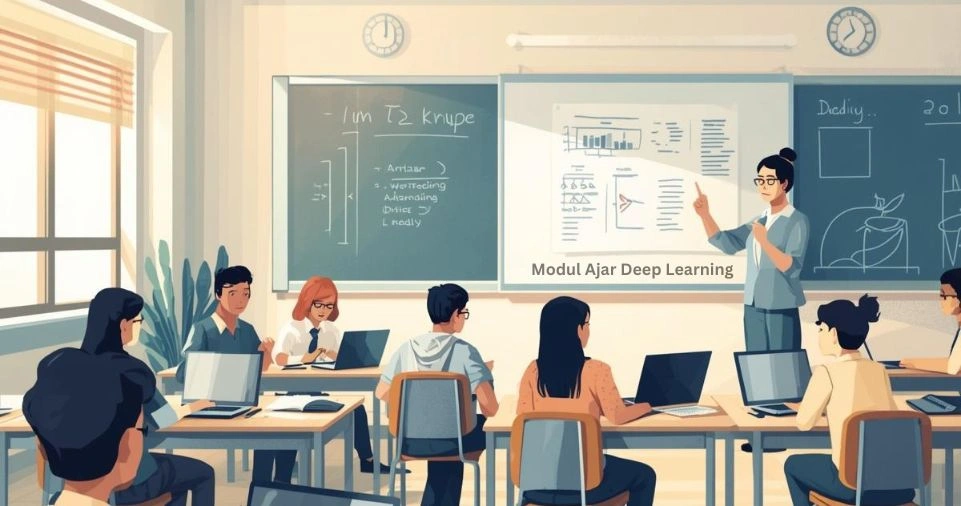
The phrase “modul ajar deep learning” is made up of two distinct parts that together form a powerful concept in Indonesian education. “Modul ajar” literally translates to “teaching module” — a structured instructional document that guides a teacher through a unit of learning. “Deep learning” in this educational context does not refer to artificial intelligence or neural networks. Instead, it refers to a pedagogical approach that emphasizes depth of understanding, critical thinking, real-world application, and character formation.
In simple terms, a modul ajar deep learning is a ready-to-use, structured teaching module that integrates the principles of Pembelajaran Mendalam (Deep Learning) — the official Indonesian term — into every component of the instructional design. It goes far beyond a traditional lesson plan by embedding student-centered activities, authentic assessments, and reflective learning practices throughout.
Unlike surface learning, where students memorize facts to pass tests and quickly forget the material, deep learning ensures that students truly internalize knowledge, connect new information to what they already know, and can apply their learning to real-life situations. This is the core philosophy behind every modul ajar deep learning you will encounter in the Indonesian education system today.
2. Who Invented Deep Learning in Education? — The Origin & History
To fully understand modul ajar deep learning, it is essential to trace where this approach came from — both globally and within Indonesia.
2.1 Global Origin of Deep Learning as a Teaching Approach
The concept of deep learning in education was first introduced in academic literature in the mid-1970s by Swedish researchers Ference Marton and Roger Saljo. In their landmark 1976 study on how university students read and process academic texts, they discovered a fundamental difference in how students approached learning. Some students processed information at a surface level — focusing on memorizing specific facts or sentences to answer test questions. Others processed information at a deep level — focusing on understanding the underlying meaning, structure, and implications of what they read.
This discovery gave birth to the terms “deep approach” and “surface approach” to learning, which became foundational concepts in educational psychology and instructional design worldwide. Over the following decades, scholars including John Biggs (Australia), Noel Entwistle (UK), and David Ausubel (USA) expanded this research, contributing frameworks such as constructive alignment, meaningful learning theory, and the SOLO taxonomy — all of which influence the modern conception of deep learning.
2.2 Who Introduced Deep Learning in Indonesia?
In the Indonesian context, the concept of deep learning as an official educational approach was championed and popularized by Prof. Dr. Abdul Mu’ti, M.Ed., who served as Indonesia’s Minister of Primary and Secondary Education (Menteri Pendidikan Dasar dan Menengah / Mendikdasmen) starting in late 2024. Upon taking office, Prof. Abdul Mu’ti introduced deep learning as a complementary pedagogical framework to be integrated into the implementation of Kurikulum Merdeka and Kurikulum 2013 across all levels of schooling.
Importantly, Prof. Abdul Mu’ti clarified from the outset that deep learning is NOT a new curriculum — it is a teaching approach, a philosophy of how learning should happen inside the classroom. To honor the Indonesian language and align with national linguistic standards, the government formally renamed the approach “Pembelajaran Mendalam” (PM), though the English term “deep learning” continues to be widely used in educational circles, teacher communities, and search engines — which is why the keyword modul ajar deep learning remains the dominant search term.
| Aspect | Global Deep Learning | Indonesian Deep Learning (PM) |
| Originators | Marton & Saljo (1976), Biggs, Entwistle | Prof. Dr. Abdul Mu’ti, M.Ed. (2024) |
| Context | University-level academic research | Primary & secondary education (SD–SMA) |
| Official Name | Deep Learning / Deep Approach | Pembelajaran Mendalam (PM) |
| Focus | Student cognition & information processing | Holistic learning: mindful, meaningful, joyful |
| Application | Higher education, cognitive science | All school levels, all subjects, K-13 & Merdeka |
3. When Did Deep Learning Start in Indonesia? — The Official Timeline
Understanding the timeline of modul ajar deep learning helps teachers stay compliant with the latest government directives and prepare their instructional materials accordingly.
| Period | Event / Milestone |
| October 2024 | Prof. Abdul Mu’ti appointed as Mendikdasmen; deep learning introduced as a new pedagogical direction |
| November 2024 | Public announcement: deep learning to be integrated into national teaching practices |
| December 2024 | Official clarification: deep learning is NOT a new curriculum but a teaching approach |
| Early 2025 | Term officially renamed ‘Pembelajaran Mendalam’ (PM) in government documents |
| July 18, 2025 | Kepala Pusat Kurikulum dan Pembelajaran Kemendikdasmen announces formal implementation |
| Academic Year 2025/2026 | Pembelajaran Mendalam (Deep Learning) fully integrated via Permendikdasmen No. 13 Tahun 2025 |
| Ongoing | Teacher training, PMM platform updates, and modul ajar templates released for all jenjang |
4. Where Is Deep Learning Applied? — Scope & Coverage
One of the most common questions teachers ask is: “Does modul ajar deep learning apply to my subject and school level?” The answer is a definitive yes — deep learning applies across all educational levels and all subjects in Indonesia.
4.1 School Levels Covered
- TK / PAUD — Early childhood: sensory exploration, character foundations, play-based learning
- SD / MI (Kelas 1–6) — Primary school: experiential learning, project-based activities, local context
- SMP / MTs (Kelas 7–9) — Junior high: contextual, collaborative, and inquiry-based modules
- SMA / MA / SMK (Kelas 10–12) — Senior high: research-based, technology-integrated, self-directed learning
4.2 Subjects Covered
Modul ajar deep learning is NOT limited to science or technology subjects. It applies universally to:
- Bahasa Indonesia & Bahasa Inggris (Language Arts)
- Matematika (Mathematics)
- IPA / Sains (Natural Sciences)
- IPS (Social Sciences)
- Pendidikan Agama Islam & Budi Pekerti (Religious Education)
- Seni Budaya (Arts & Culture)
- PJOK (Physical Education)
- Informatika / Coding / AI (Technology — new in 2025/2026 for Kelas 5 & 6 SD)
- Sejarah, Geografi, Ekonomi (History, Geography, Economics — SMA level)
4.3 Curriculum Compatibility
A critical point that many teachers overlook: modul ajar deep learning is compatible with BOTH active curricula in Indonesia. You do not need to switch curricula to use it.
| Curriculum | Compatible with Deep Learning? | Notes |
| Kurikulum Merdeka | Yes — fully integrated | Primary curriculum from 2025/2026 (Permendikdasmen No. 13/2025) |
| Kurikulum 2013 (K-13) | Yes — adaptable | Schools still on K-13 can apply Pembelajaran Mendalam principles |
| Kurikulum Merdeka Mandiri Belajar | Yes | Flexible implementation, teacher-led customization encouraged |
5. Why Is Modul Ajar Deep Learning Important? — The Reasons
The push toward modul ajar deep learning is not arbitrary. It is a direct response to measurable challenges in Indonesian education and a proactive strategy to prepare students for the demands of the 21st century.
5.1 The Problem It Solves
- Low literacy and numeracy scores: Indonesia’s PISA rankings have consistently highlighted that many students can perform procedural tasks but struggle with application and reasoning — the hallmark of surface learning.
- Passive classroom culture: Traditional teaching methods — heavy on lectures, rote memorization, and standardized testing — have created classrooms where students receive knowledge rather than construct it.
- Disconnection from real life: Students often fail to see the relevance of what they learn to their daily lives, reducing motivation and long-term retention.
- Inequality across regions: Deep learning, when properly scaffolded into modul ajar, allows teachers in 3T areas (Tertinggal, Terdepan, Terluar) to deliver quality, contextualized education without requiring expensive resources.
5.2 The Benefits of Using Modul Ajar Deep Learning
| Benefit | Impact on Students | Impact on Teachers |
| Critical Thinking Development | Students analyze, evaluate, and create rather than just recall | Shifts teacher role from lecturer to facilitator |
| Meaningful Engagement | Learning connected to real life increases intrinsic motivation | Lessons become more dynamic and responsive |
| Character Formation | Profil Pelajar Pancasila dimensions are embedded naturally | Administrative requirements met within teaching activities |
| Better Retention | Deep understanding leads to long-term knowledge retention | Less reteaching required in subsequent units |
| 21st Century Skills | Collaboration, communication, creativity, critical thinking | Prepares students for higher education and the workforce |
| Regulatory Compliance | Aligns with Permendikdasmen No. 13 Tahun 2025 | Satisfies accreditation and administrative requirements |
6. The 3 Core Pillars of Deep Learning — Mindful, Meaningful & Joyful
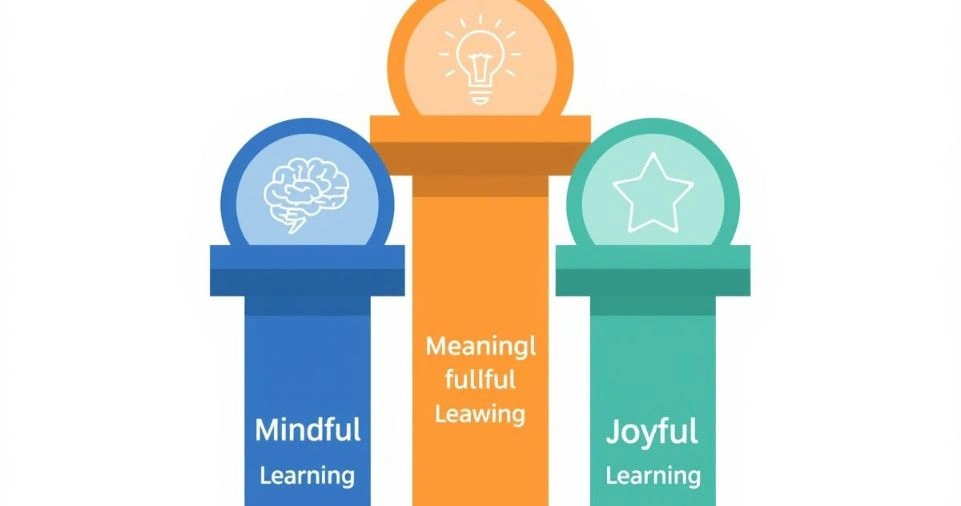
Every modul ajar deep learning must be built around three inseparable pillars. These are not optional additions — they are the philosophical foundation that distinguishes a deep learning module from a conventional RPP.
Pillar 1: Mindful Learning (Pembelajaran Berkesadaran)
Mindful learning means that both the teacher and students are fully present, aware, and intentional in the learning process. It recognizes that every student comes to the classroom with unique backgrounds, prior knowledge, emotional states, and learning styles. A mindful teacher designs lessons that acknowledge this diversity.
Practical applications in your modul ajar deep learning:
- Begin every lesson with a brief icebreaker, reflective question, or mood check-in
- Use asesmen diagnostik (diagnostic assessment) before introducing new material
- Differentiate instruction based on student readiness levels
- Include reflection prompts at the end of each learning activity
- Design activities that connect new content to students’ prior lived experiences
Pillar 2: Meaningful Learning (Pembelajaran Bermakna)
Meaningful learning ensures that what students learn has clear relevance and application to their real world. Drawing from David Ausubel’s Assimilation Theory, meaningful learning occurs when new information is deliberately connected to existing knowledge structures in the learner’s mind — rather than being stored as isolated, disconnected facts.
Practical applications in your modul ajar deep learning:
- Frame every lesson around a real-world problem, question, or scenario
- Use Project-Based Learning (PjBL) to produce tangible, relevant outcomes
- Connect academic concepts to local community issues and student interests
- Include interdisciplinary connections (e.g., link mathematics to economics or science to health)
- Design LKPD (Lembar Kerja Peserta Didik) with open-ended, context-rich tasks
Pillar 3: Joyful Learning (Pembelajaran Menggembirakan)
Joyful learning is often misunderstood as simply “making class fun.” It goes deeper than that. Joyful learning means creating a psychologically safe, emotionally supportive, and intellectually stimulating classroom environment where students feel genuinely excited to learn, free to take risks, and celebrated for their curiosity.
Practical applications in your modul ajar deep learning:
- Incorporate gamification elements into lesson activities
- Allow student choice in how they demonstrate their learning (presentations, videos, posters)
- Use collaborative group work that encourages peer teaching
- Celebrate effort and improvement, not just correct answers
- Introduce humor, storytelling, and creative challenges into your lessons
| Pillar | Indonesian Term | Core Question | Key Classroom Strategy |
| Mindful Learning | Berkesadaran | Are students aware and present? | Diagnostic assessment + reflection journals |
| Meaningful Learning | Bermakna | Is this relevant to real life? | PBL / PjBL + real-world problem framing |
| Joyful Learning | Menggembirakan | Are students genuinely engaged? | Gamification + student choice + celebration |
7. Components of Modul Ajar Deep Learning — What Must Be Included
A properly structured modul ajar deep learning must contain specific components as outlined in the Kurikulum Merdeka framework and the Pembelajaran Mendalam guidelines from Kemendikdasmen. Missing any of these core components can result in a module that fails to meet accreditation standards.
7.1 Core Components (Komponen Inti — Mandatory)
| Component | Indonesian Term | Description |
| Learning Outcomes | Capaian Pembelajaran (CP) | Phase-based competency targets issued by Kemendikdasmen — the foundation of all lesson planning |
| Learning Objective Flow | Alur Tujuan Pembelajaran (ATP) | A logical sequence mapping how CP will be achieved across units and topics |
| Learning Objectives | Tujuan Pembelajaran (TP) | Specific, measurable outcomes for each individual lesson or activity |
| Achievement Criteria | KKTP (Kriteria Ketercapaian Tujuan Pembelajaran) | Clear standards that define when a learning objective has been successfully met |
| Student Worksheets | LKPD (Lembar Kerja Peserta Didik) | Activity-based student worksheets designed around deep learning tasks |
| Formative Assessment | Asesmen Formatif | Ongoing assessment during the learning process (observations, quizzes, discussions) |
| Summative Assessment | Asesmen Sumatif | End-of-unit assessment measuring overall achievement of learning objectives |
| Pancasila Student Profile | Profil Pelajar Pancasila | At least 2–3 character dimensions explicitly integrated into the lesson design |
7.2 Supporting Components (Komponen Pendukung — Highly Recommended)
- PROTA (Program Tahunan) — Annual teaching program mapped to the full academic year
- PROSEM (Program Semester) — Semester-level breakdown of teaching units
- Jurnal Mengajar Harian — Daily teaching journal for reflective practice and documentation
- Daftar Hadir & Daftar Nilai — Attendance records and grade tracking sheets
- Kisi-Kisi Soal & Rubrik Penilaian — Assessment blueprints and scoring rubrics
- Media Pembelajaran — Supporting materials: presentations (PPT), videos, infographics, digital tools
- Aplikasi Rapor — Grade report application compatible with the school’s reporting system
- Kalender Akademik (KALDIK) — Academic calendar integration for scheduling
8. How to Create a Modul Ajar Deep Learning — Step-by-Step Guide
Creating a high-quality modul ajar deep learning from scratch can feel overwhelming, especially for teachers encountering this framework for the first time. The following step-by-step process breaks it down into manageable stages.
Step 1 — Identify Your Capaian Pembelajaran (CP)
Start by downloading and carefully reading the latest CP document for your subject and school level from the official Kemendikdasmen website. The CP defines the destination — the competencies students must achieve by the end of a specific learning phase. Every component of your modul ajar must trace back to a specific CP.
Step 2 — Build Your Alur Tujuan Pembelajaran (ATP)
Break down the CP into a logical sequence of smaller, teachable learning objectives. Your ATP is essentially the roadmap from the starting point to the CP destination. Arrange your learning objectives from simple to complex, from concrete to abstract, ensuring each builds on the previous one. The ATP spans the entire semester or year.
Step 3 — Write Clear Tujuan Pembelajaran (TP) for Each Lesson
For each unit or lesson within your ATP, write specific Tujuan Pembelajaran using the ABCD format: Audience (who), Behavior (what students will do), Condition (under what circumstances), and Degree (to what standard). These must be observable and measurable.
Step 4 — Design Deep Learning Activities
This is the heart of your modul ajar deep learning. Choose instructional strategies that embody the three pillars. The following models are most aligned with deep learning principles:
- Problem-Based Learning (PBL) — Students investigate and solve a real, complex problem
- Project-Based Learning (PjBL) — Students design and produce a meaningful product or output
- Inquiry-Based Learning — Students discover knowledge through guided investigation and questioning
- Cooperative Learning — Students work in structured collaborative groups, each with defined roles
- Discovery Learning — Students explore and construct understanding through hands-on exploration
Step 5 — Create Contextual LKPD
Your LKPD should not be a simple worksheet of multiple-choice or fill-in-the-blank questions. A deep learning LKPD is characterized by:
- Open-ended, higher-order thinking (HOTS) questions that require analysis and evaluation
- Real-world scenarios that connect the lesson topic to students’ lives and communities
- Space for student reflection, creativity, and self-expression
- Collaborative tasks that encourage peer discussion and collective problem-solving
- Multiple ways for students to respond: written, drawn, oral, or digital
Step 6 — Design Authentic Assessments
Replace or supplement traditional tests with authentic assessments that require students to demonstrate deep understanding in meaningful contexts:
- Portofolio — a collection of student work showing growth over time
- Presentasi & Demonstrasi — students explain and demonstrate their learning
- Proyek & Produk — students create a physical or digital product as evidence of learning
- Jurnal Refleksi — students write about their learning process and personal growth
- Peer Assessment & Self-Assessment — students evaluate their own and each other’s work
Step 7 — Integrate Profil Pelajar Pancasila
Select 2–3 dimensions of the Profil Pelajar Pancasila that are authentically connected to your lesson content and activities. Do not force every dimension into every lesson. Authentic integration means the character development naturally emerges from the activities — students develop the dimension by doing, not by being told about it.
| Dimension | Indonesian | How to Integrate Naturally |
| Faith & Piety | Beriman & Bertakwa | Gratitude reflection, ethical decision-making in case studies |
| Global Diversity | Berkebinekaan Global | Cross-cultural projects, compare local vs global perspectives |
| Collaboration | Bergotong Royong | Group projects with shared accountability and peer support |
| Independence | Mandiri | Self-directed research tasks, self-assessment, portfolio building |
| Critical Reasoning | Bernalar Kritis | Analyzing evidence, evaluating sources, solving open problems |
| Creativity | Kreatif | Design challenges, innovative product creation, artistic expression |
9. Contoh Modul Ajar Deep Learning — Examples for All Levels
The following section provides structured examples of modul ajar deep learning for each school level, demonstrating how the framework applies across different ages, subjects, and contexts.
9.1 Contoh Modul Ajar Deep Learning — SD (Elementary School, Kelas 1–6)
Characteristics: Sensory-rich, play-based, highly visual, connected to the immediate physical environment. Activities should be short, varied, and involve movement where possible.
| Component | Example Content (SD Kelas 4 — IPA) |
| Subject & Level | Ilmu Pengetahuan Alam (IPA) — Kelas 4 SD / Phase B |
| Topic | Living Things and Their Environment (Makhluk Hidup dan Lingkungannya) |
| Capaian Pembelajaran | Students understand the relationship between living organisms and their natural environment |
| Tujuan Pembelajaran | Students can identify and explain 3 ways living things depend on their environment |
| Deep Learning Model | Project-Based Learning (PjBL) — students build a terrarium/mini ecosystem |
| 3 Pillars Applied | Mindful: reflection on nature; Meaningful: real ecosystem; Joyful: hands-on building |
| LKPD Activity | Observe the school garden, record findings, sketch the food chain, present to class |
| Asesmen | Portfolio of observation drawings + oral presentation + peer feedback |
| Profil Pelajar Pancasila | Bernalar Kritis (observation & analysis) + Kreatif (ecosystem design) |
9.2 Contoh Modul Ajar Deep Learning — SMP (Junior High, Kelas 7–9)
Characteristics: More abstract reasoning, collaborative projects, community-oriented problem solving, introduction to digital literacy and research skills.
| Component | Example Content (SMP Kelas 8 — IPS) |
| Subject & Level | Ilmu Pengetahuan Sosial (IPS) — Kelas 8 SMP / Phase D |
| Topic | Climate Change and Its Impact on Local Communities |
| Capaian Pembelajaran | Students analyze the interaction between human activity and environmental sustainability |
| Tujuan Pembelajaran | Students can identify causes, effects, and local solutions to climate change in their region |
| Deep Learning Model | Problem-Based Learning (PBL) — research a local environmental issue and propose solutions |
| 3 Pillars Applied | Mindful: awareness of personal environmental impact; Meaningful: real local issue; Joyful: solution competition |
| LKPD Activity | Interview community members, gather data, create an infographic, present findings |
| Asesmen | Research report + infographic + class debate on proposed solutions + self-assessment |
| Profil Pelajar Pancasila | Bernalar Kritis + Bergotong Royong + Berkebinekaan Global |
9.3 Contoh Modul Ajar Deep Learning — SMA (Senior High, Kelas 10–12)
Characteristics: Research-driven, technology-integrated, self-directed, career and higher education oriented. Modules should reflect complexity and require higher-order thinking throughout.
| Component | Example Content (SMA Kelas 11 — Ekonomi) |
| Subject & Level | Ekonomi — Kelas 11 SMA / Phase F |
| Topic | Digital Creative Economy and Student Entrepreneurship |
| Capaian Pembelajaran | Students analyze economic opportunities in the digital era and evaluate entrepreneurial strategies |
| Tujuan Pembelajaran | Students can design a viable digital business concept and present a business pitch |
| Deep Learning Model | Project-Based Learning (PjBL) — design a digital startup prototype |
| 3 Pillars Applied | Mindful: reflect on personal skills & market needs; Meaningful: real economic application; Joyful: pitch competition format |
| LKPD Activity | Market research, SWOT analysis, business model canvas, digital pitch deck creation |
| Asesmen | Business plan document + pitch presentation + peer investor panel Q&A + self-reflection |
| Profil Pelajar Pancasila | Mandiri + Kreatif + Bernalar Kritis + Bergotong Royong |
10. Modul Ajar Deep Learning vs. RPP Konvensional — Key Differences
A direct comparison between traditional RPP-based teaching and modul ajar deep learning reveals not just procedural differences but a fundamental shift in the philosophy of teaching and learning.
| Aspect | RPP Konvensional | Modul Ajar Deep Learning |
| Core Philosophy | Knowledge transfer from teacher to student | Knowledge construction by the student |
| Teacher Role | Primary instructor and knowledge source | Facilitator, guide, and learning designer |
| Student Role | Passive recipient of information | Active explorer, creator, and collaborator |
| Learning Activities | Lectures, note-taking, textbook exercises | PBL, PjBL, inquiry, collaborative projects |
| Assessment Type | Written tests, multiple choice, memorization | Authentic: portfolios, presentations, projects |
| Document Components | KI, KD, Indikator, Kegiatan Pembelajaran | CP, ATP, TP, KKTP, LKPD, Asesmen, PPP |
| Curriculum Alignment | Primarily Kurikulum 2013 | Kurikulum Merdeka + K-13 (adaptable) |
| Character Education | Separate from subject content | Embedded via Profil Pelajar Pancasila |
| Real-World Relevance | Minimal — abstract and textbook-driven | High — contextualized to student lives |
| Technology Integration | Optional and rare | Encouraged and planned for |
| Differentiation | One-size-fits-all approach | Flexible, responsive to student diversity |
| Learning Outcome | Surface knowledge (short-term retention) | Deep understanding (long-term transfer) |
11. Practical Tips for Implementing Modul Ajar Deep Learning

Theory without implementation is just knowledge on paper. Here are battle-tested, practical tips that Indonesian teachers can apply immediately to bring their modul ajar deep learning to life in real classrooms.
- Start with ONE deep learning module per semester — do not try to transform all your lessons at once. Master the approach gradually.
- Use the three-pillar test: Before finalizing your module, ask — Is this mindful? Is this meaningful? Is this joyful? If any pillar is missing, redesign that section.
- Build a question bank of pemantik (provocative starter questions) to open each lesson with genuine curiosity and engagement.
- Reduce teacher talk time to no more than 30% of the lesson — the remaining 70% should belong to students.
- Collaborate with fellow teachers: interdisciplinary modul ajar deep learning (combining two subjects) creates the richest learning experiences.
- Use the Platform Merdeka Mengajar (PMM) to access official templates, CP documents, and peer-reviewed modul ajar examples.
- Document everything: your teaching journal, student portfolios, and assessment results are your evidence for accreditation.
- Invite parents and the community into project-based activities — this naturally fulfills the meaningful learning pillar.
- Be flexible: deep learning is student-centered, meaning your module may need to adapt as you discover what resonates with your specific students.
12. Frequently Asked Questions (FAQ) — Modul Ajar Deep Learning
Q1: Is modul ajar deep learning the same as a new curriculum?
No. This is one of the most common misconceptions. Modul ajar deep learning is NOT a new curriculum. It is a pedagogical approach — a philosophy and method of teaching — that is integrated into the existing Kurikulum Merdeka and Kurikulum 2013. The curriculum framework remains the same; what changes is HOW teachers design and deliver learning experiences within that framework.
Q2: Does modul ajar deep learning apply to all subjects?
Yes. Deep learning is a universal pedagogical approach applicable to every subject across every school level — from Bahasa Indonesia and Mathematics to Physical Education, Religious Studies, Arts, and the newly introduced Coding and AI subjects for SD Kelas 5 and 6 in the 2025/2026 curriculum.
Q3: What is the difference between surface learning and deep learning?
Surface learning (pembelajaran dangkal) involves memorizing information for immediate recall — typically to pass a test — without genuinely understanding or connecting it to broader knowledge. Deep learning (pembelajaran mendalam) involves actively constructing understanding, making connections between concepts, applying knowledge to new situations, and reflecting on the learning process. The fundamental difference is not how much students know but how well they understand and can use what they know.
Q4: Can teachers still use modul ajar deep learning if their school uses K-13?
Absolutely. The Pembelajaran Mendalam approach has been explicitly designed to be adaptable to both Kurikulum Merdeka and Kurikulum 2013. Teachers using K-13 can adopt the deep learning principles — the three pillars, authentic assessment, and student-centered activities — while keeping the KI/KD structure of K-13 intact.
Q5: How long does it take to write a complete modul ajar deep learning?
An experienced teacher familiar with the framework can complete a single-unit modul ajar deep learning in approximately 3–5 hours. For beginners, plan for 8–12 hours for the first module. The investment decreases significantly as you develop templates, question banks, and LKPD libraries that can be adapted across units and subjects. Using official templates from Platform Merdeka Mengajar also significantly reduces preparation time.
Q6: What does Profil Pelajar Pancasila mean in the context of modul ajar deep learning?
Profil Pelajar Pancasila (PPP) is the Indonesian government’s vision of the ideal graduate — a student who is not only academically competent but also has strong national character, global awareness, and ethical integrity. In modul ajar deep learning, PPP dimensions must be authentically embedded into learning activities — not treated as a separate subject or an add-on checklist, but as natural outcomes of how the lesson is designed and experienced.
Q7: Are there official templates for modul ajar deep learning from the government?
Yes. Official guidelines, CP documents, ATP examples, and modul ajar templates are available through the Platform Merdeka Mengajar (PMM) — the official teacher development platform operated by Kemendikdasmen. Additionally, the government portal for teachers provides access to uploaded karya (works) including sample modul ajar submitted by teachers nationwide. Always ensure you are using the most current version, as templates are updated with each academic year.
Q8: What is the role of LKPD in modul ajar deep learning?
LKPD (Lembar Kerja Peserta Didik) in a deep learning context is fundamentally different from traditional student worksheets. Rather than a list of comprehension or calculation exercises, a deep learning LKPD is a structured learning scaffold that guides students through a meaningful investigation or project. It includes higher-order thinking prompts, real-world scenarios, space for creative expression, collaborative tasks, and built-in reflection opportunities. The LKPD is one of the most powerful tools in a deep learning module because it directly determines the quality of the student’s learning experience.
13. Conclusion — Why Every Teacher Needs Modul Ajar Deep Learning
Modul ajar deep learning represents one of the most significant shifts in Indonesian education in recent memory — not because it introduces new content, but because it fundamentally reimagines how learning should happen. Championed by Mendikdasmen Prof. Abdul Mu’ti and rooted in decades of global educational research tracing back to Marton and Saljo’s groundbreaking 1976 work, this approach challenges every teacher to move beyond the familiar comfort of lectures and standardized tests and toward a richer, more human model of education.
Whether you are a teacher at an SD in a rural 3T region, a seasoned SMA educator in a major city, or an administrator designing professional development for your school, modul ajar deep learning offers a practical, scalable, and research-backed framework for transforming the quality of education you deliver.
The three pillars — Mindful, Meaningful, and Joyful — are not just educational theory. They are a promise to your students: that their time in your classroom will be spent on learning that matters, delivered in a way that respects who they are, and designed to stay with them long after the final bell rings.