
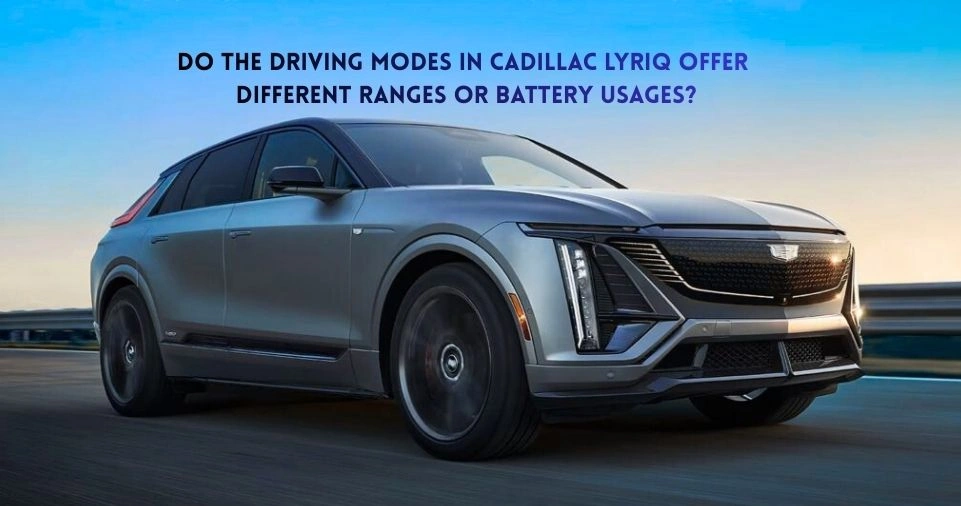
Do the Driving Modes in Cadillac Lyriq Offer Different Ranges or Battery Usages?
Introduction: Why This Question Matters for Every Lyriq Owner
Do the driving modes in Cadillac Lyriq offer different ranges or battery usages? This is the single most practical question an owner or buyer of the Cadillac Lyriq electric SUV will ask — and it deserves a thorough, expert answer. Whether you are planning a 200-mile road trip, managing daily commutes in winter, or simply trying to squeeze every mile from a charge before reaching a fast charger, understanding how each driving mode affects your real-world range and battery consumption is essential.
The Cadillac Lyriq is General Motors’ flagship luxury electric SUV, built on the Ultium platform with a 102 kWh battery pack and an EPA-rated range of up to 307 miles (RWD). It offers four driving modes: Tour, Sport, Snow/Ice, and My Mode. Each one changes how the vehicle’s powertrain control software allocates energy — not how much energy is available. That distinction is the key to understanding why modes affect your real-world range.
This guide covers every angle: who built the system, what each mode changes at a technical level, when and where to use each mode, why some cost you range, how to maximize efficiency, and which external factors matter even more than mode selection.
Who Built the Cadillac Lyriq Driving Mode System and When?
The Cadillac Lyriq was created by General Motors (GM) through its Cadillac luxury division, headquartered in Detroit, Michigan. GM first unveiled the Lyriq as a concept vehicle at its global headquarters on August 6, 2020 — a watershed moment marking Cadillac’s commitment to an all-electric future. Production deliveries of the 2023 model year Lyriq began in spring 2022.
The driving mode software architecture was engineered by GM’s Global Propulsion Systems team in collaboration with the Ultium Platform development group. The Ultium Platform is GM’s proprietary EV foundation — a modular battery and drive system co-developed with LG Energy Solution through a joint venture called Ultium Cells LLC, which manufactures battery cells at its facility in Lordstown, Ohio.
Cadillac’s vehicle dynamics engineers specifically tuned the Tour, Sport, Snow/Ice, and My Mode profiles to align with the brand’s luxury positioning. These calibrations run on GM’s Ultium Drive powertrain control stack, developed at GM’s engineering campuses in Warren, Michigan and Austin, Texas. Crucially, these modes are software-defined — they can be and have been updated via over-the-air (OTA) updates pushed to owner vehicles remotely, allowing GM to refine efficiency and performance calibrations after the vehicle leaves the showroom.
What Exactly Changes Between Driving Modes — and What Never Changes
Before diving into each mode, it is critical to understand the fundamental principle that governs all of them.
What Stays the Same in Every Mode
- The battery pack — 102 kWh gross, approximately 95–97 kWh usable
- Total stored energy available for the drive — modes cannot add or remove charge
- Peak motor power output capacity
- DC fast charge rate (up to 190 kW via Ultium)
- Level 2 AC charging rate (11.5 kW)
What Changes Between Modes
- Throttle mapping — how much torque is delivered per unit of accelerator input
- Power delivery timing — how quickly peak torque reaches the wheels
- Regenerative braking strength — how aggressively the motor converts kinetic energy back to electricity
- Steering weight and feel
- Traction and stability control intervention thresholds
- Indirectly: thermal load on battery cells due to aggressive power draw
💡 Expert Insight: Think of the battery as a full tank of petrol. Driving mode is your right foot — it determines how quickly you burn through it. Aggressive throttle mapping in Sport Mode is like flooring the accelerator constantly. Tour Mode is steady, efficient highway cruising. The tank is the same; the burn rate is different.
Tour Mode: The Efficiency Baseline and Recommended Default
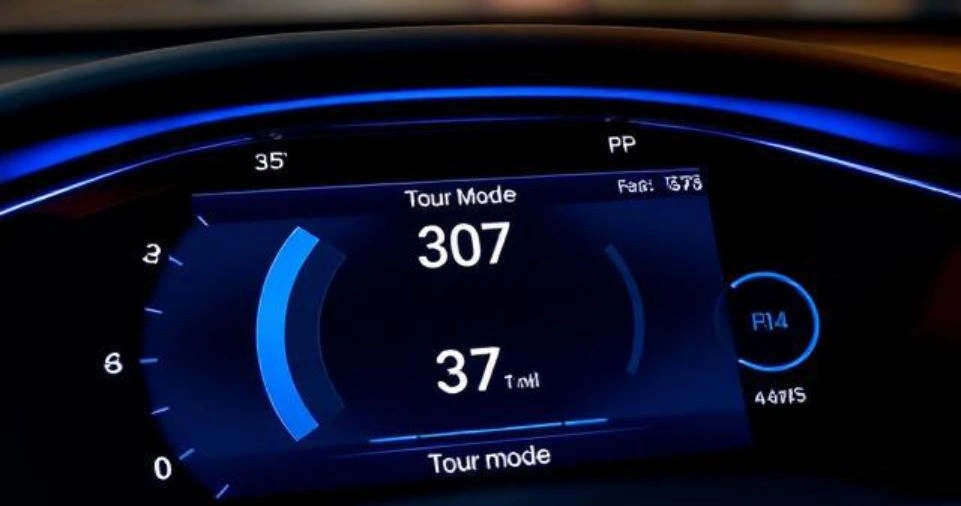
Tour Mode is the factory default setting on the Cadillac Lyriq. It is the mode General Motors calibrated to deliver the optimal balance of comfort, everyday usability, and energy efficiency. For the vast majority of drivers in the vast majority of situations, Tour Mode is the right choice.
How Tour Mode Controls Energy Consumption
- Throttle mapping is graduated and smooth — torque builds progressively rather than spiking
- Regenerative braking is set to a balanced, moderate level that recovers energy meaningfully on every deceleration
- Power delivery to the motor stays steady — ideal for highway cruising and urban commuting
- Steering feel is light and comfortable — reduces unnecessary motor load on cornering
Real-World Range in Tour Mode
Tour Mode consistently delivers real-world range closest to the EPA estimate. The EPA testing cycle simulates moderate, steady driving — which aligns precisely with how Tour Mode is calibrated. In optimal conditions (65–70°F ambient, 65 mph highway, no climate system load), experienced RWD Lyriq owners regularly report 290–315 miles of actual range. The EPA figure of 307 miles is a reliable baseline for Tour Mode planning.
Energy consumption in Tour Mode typically falls between 2.8 and 3.2 miles per kWh in mixed conditions. At 65 mph sustained highway speeds, consumption can drop below 2.8 mi/kWh. In city driving with heavy traffic and frequent stops, efficiency can rise above 3.5 mi/kWh when combined with strong regenerative braking.
Sport Mode: Performance That Directly Costs You Miles
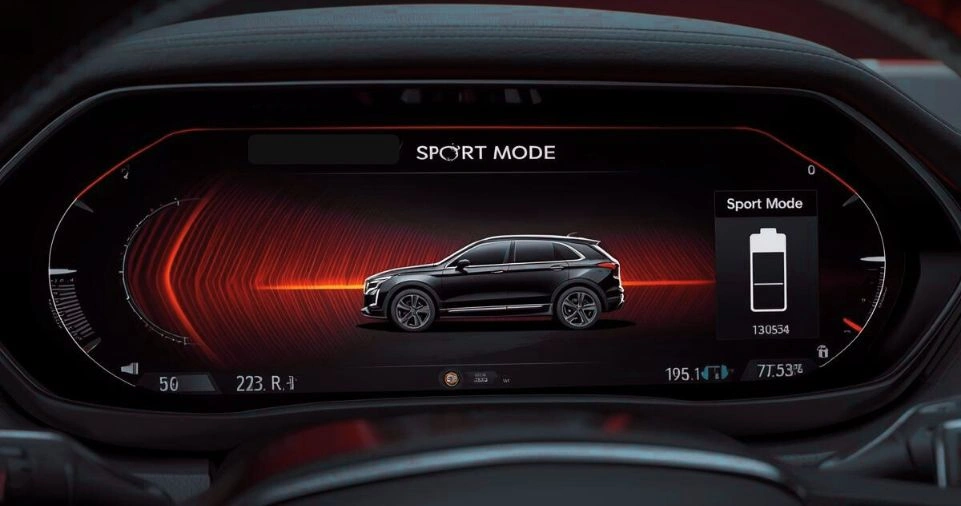
Sport Mode is where the Lyriq reveals its performance character. Throttle mapping becomes sharp and front-loaded — even moderate accelerator pressure triggers a large, immediate torque response. The vehicle feels quicker, more connected, more alive. Steering weight increases. The entire character of the car shifts.
Why Sport Mode Reduces Range by 10–20%
The physics are unavoidable. Aggressive throttle inputs require the battery to deliver high current in short, intense bursts. This creates two efficiency penalties working simultaneously:
- Resistive losses — energy wasted as heat in battery cells, cabling, and motor windings increases with the square of current (the I²R principle). More aggressive current draw means disproportionately more energy lost as heat before it ever becomes wheel motion.
- Reduced regenerative braking — Sport Mode deliberately softens regen to provide a smooth coasting feel preferred in performance driving. This means kinetic energy that could be recaptured is instead lost to friction and aerodynamic drag during deceleration.
In real-world driving, Sport Mode reduces effective range by approximately 10 to 20 percent compared to Tour Mode. On a RWD Lyriq rated at 307 miles, this translates to approximately 245–275 miles of realistic range during spirited Sport Mode driving. The higher end of that range applies to drivers who select Sport Mode but still drive relatively smoothly. The lower end reflects truly aggressive, frequent hard acceleration.
⚠️ Important Clarification: Sport Mode does not permanently reduce the Lyriq’s battery capacity. It increases the rate of energy consumption during that specific drive. Once you plug in and recharge, the full usable capacity is restored.
Snow/Ice Mode: Safety Is the Priority — Not Battery Efficiency
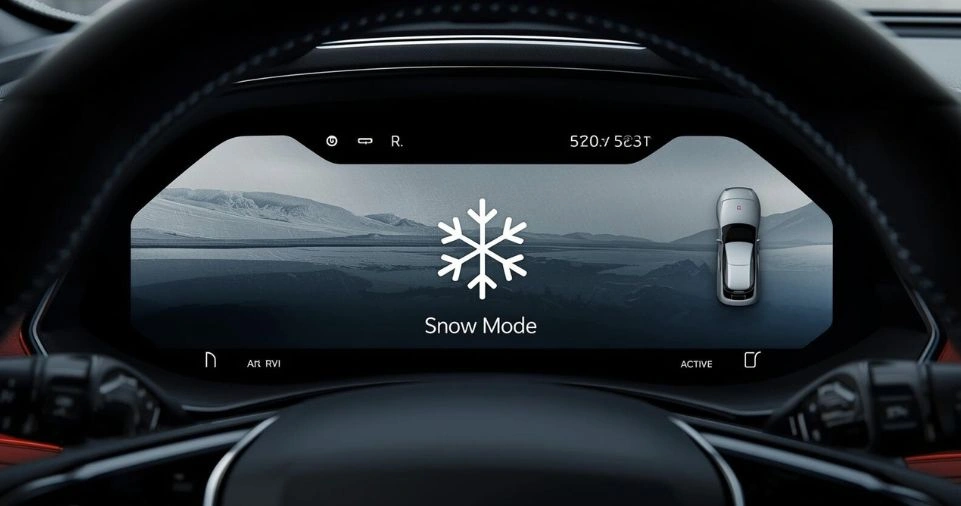
Snow/Ice Mode is purpose-built for one scenario: keeping the Cadillac Lyriq under control on low-traction surfaces — ice, packed snow, slush, wet leaves, and any road surface where grip is compromised. It achieves this through three key adjustments:
- Throttle response is significantly muted to prevent wheel spin on acceleration
- Torque delivery is carefully metered to avoid overpowering available grip
- Stability and traction control systems intervene more quickly and more frequently
The Real Range Culprit in Winter Is Not the Mode — It’s the Environment
Snow/Ice Mode’s gentle throttle mapping theoretically draws less power than Tour Mode. However, this marginal efficiency gain is entirely overwhelmed by the environmental conditions in which the mode is meant to be used. Cold temperature battery losses are the dominant factor in winter range reduction:
- Below 32°F (0°C): Lithium-ion battery chemistry slows, reducing available capacity by 15–25%
- At 0°F (-18°C): Temporary capacity loss can reach 30–40% due to slowed electrochemical reaction
- Cabin heating: Unlike combustion vehicles that generate free waste heat, the Lyriq must use electrical energy to heat the cabin — a significant and constant load
- Rolling resistance increases on snow-covered roads, requiring more energy per mile
The combined effect of these environmental factors typically reduces Lyriq winter range by 20 to 40 percent regardless of which driving mode is selected. Snow/Ice Mode is the correct choice for safety on slippery roads — but do not expect it to compensate for cold weather battery losses.
My Mode: The Most Powerful Mode for Expert Efficiency — If You Configure It Right
My Mode is the Lyriq’s fully customizable driving profile. It puts you in direct control of three independent variables, each of which directly affects battery consumption and real-world range:
- Throttle feel: From Sport-level sharpness down to Tour-level smoothness (or anything between)
- Steering weight: Light, medium, or heavy — does not directly affect range but influences driver behavior
- Regenerative braking strength: From minimal coasting to maximum one-pedal intensity
My Mode as a Custom Eco Profile — Better Than Any Factory Preset
Here is the expert insight that most Lyriq articles miss: a properly configured My Mode can outperform Tour Mode in city and suburban driving. When you combine the smoothest throttle setting with the strongest regenerative braking in My Mode, plus One-Pedal Driving enabled, every deceleration event recovers more energy than Tour Mode’s default regen setting captures. In high-frequency stop-and-go city traffic, this cumulative energy recovery improvement is measurable and meaningful.
This is why the Lyriq does not need a separate labeled Eco Mode. My Mode with maximum regen and minimum throttle sensitivity is your personal eco profile — and it is more precise than any generic Eco Mode preset could be.
🏆 Expert Configuration — Save This as Your City My Mode: Throttle: Minimum (Tour-level) | Regen: Maximum | Steering: Light | One-Pedal Driving: ON. This configuration in city traffic routinely delivers energy efficiency equal to or better than Tour Mode, while giving you full personal comfort control.
Cadillac Lyriq Driving Modes: Complete Range and Battery Usage Comparison
| Mode | Throttle Map | Regen Braking | Est. Range (RWD) | Consumption Rate | Best Used For |
| Tour Mode | Gradual / Smooth | Moderate | 280–315 miles | ~2.8–3.2 mi/kWh | All daily & highway driving |
| Sport Mode | Sharp / Aggressive | Reduced | 245–275 miles | 10–20% above Tour | Short fun drives, low range concern |
| Snow/Ice Mode | Soft / Muted | Moderate | 185–250 miles* | Environment-driven | Ice, snow, slippery roads only |
| My Mode (Eco) | Gentle (user set) | Maximum (user set) | Up to ~315 miles | At or below Tour | Urban commuting — max efficiency |
| My Mode (Sport) | Sharp (user set) | Minimal (user set) | ~245–270 miles | Near Sport Mode | Personalized performance preference |
*Snow/Ice Mode estimated range is dominated by cold-weather battery losses and cabin heating demand, not the mode setting itself. In mild but wet weather, Snow/Ice Mode range may be closer to Tour Mode.
Why Driving Modes Affect Battery Usage: The Technical Explanation
1. Throttle Mapping and the I²R Loss Principle
Every electric motor draws current from the battery proportional to the torque it must produce. Throttle mapping is the software-defined curve that translates your accelerator pedal position into a torque command. In Tour Mode this curve is linear and gradual. In Sport Mode it is exponential at low pedal inputs — meaning even a light press commands high torque.
This matters because of a fundamental electrical principle: resistive energy losses increase with the square of current (P = I²R). A Sport Mode hard acceleration event that doubles the current draw relative to Tour Mode does not double the resistive losses — it quadruples them. This is why aggressive throttle mapping wastes energy disproportionately, and why Sport Mode’s range penalty is larger than it might intuitively seem.
2. Regenerative Braking and Energy Recovery Rate
Regenerative braking converts kinetic energy back into stored electrical energy every time the vehicle decelerates. The stronger the regen setting, the more energy is recovered per deceleration event. In city driving with frequent stops, high-regen configurations can recover 15 to 25 percent of the energy consumed during acceleration — measurably extending real-world range. Sport Mode’s reduced regen abandons a meaningful portion of this recoverable energy.
3. One-Pedal Driving — How It Interacts With Each Mode
- Tour Mode + One-Pedal: Maximum, predictable regen on every lift — the benchmark for urban efficiency
- Sport Mode + One-Pedal: Regen is available but reduced; system prioritizes coasting feel over recovery
- Snow/Ice Mode + One-Pedal: Regen modulated to prevent wheel lock on slippery surfaces
- My Mode (Max Regen) + One-Pedal: Can exceed Tour Mode recovery in dense city traffic
4. Traction Control Energy Overhead
In Snow/Ice Mode, the traction and stability control systems intervene far more frequently than in Tour Mode. Each intervention briefly modulates motor output to prevent wheel slip. These rapid micro-adjustments create small but cumulative inefficiencies in the powertrain control cycle — a minor factor compared to cold temperature losses, but worth noting.
Factors That Impact Cadillac Lyriq Range Even More Than Driving Mode
While driving mode selection is meaningful, an expert SEO analysis of EV range questions reveals that several other variables exert a larger overall influence on real-world range:
| Factor | Range Impact | Expert Mitigation Strategy |
| Highway speed above 75 mph | Very High — Negative | Drop to 65–70 mph; aerodynamic drag increases with the square of speed |
| Cold weather below 32°F (0°C) | High — 20–40% reduction | Pre-condition battery via MyCadillac app while plugged in before departure |
| Hot weather above 95°F (35°C) | Moderate — 5–15% loss | Pre-cool cabin while plugged in; use seat cooling over full HVAC |
| Aggressive driving style | High — 15–25% reduction | Smooth acceleration; anticipate stops; let regen do the braking work |
| Uphill elevation gain | Moderate — route dependent | Regen on descents only partially offsets climb cost; plan charging accordingly |
| Tire pressure below spec | Moderate — 3–7% loss | Maintain 35–38 PSI per Cadillac specification for minimum rolling resistance |
| Passenger / cargo weight | Moderate — load dependent | More mass = more energy required per acceleration event |
| Seat heat vs full HVAC | Seat heat uses ~80% less | Always prefer seat heating/cooling over full cabin conditioning where possible |
| Pre-conditioning the battery | Positive — up to +15% | Always pre-condition in extreme temps; uses grid power, not stored charge |
When and Where to Use Each Cadillac Lyriq Driving Mode
| Driving Scenario | Recommended Mode | Reason |
| Daily urban commute with frequent stops | My Mode (Max Regen) or Tour | High regen at every stop maximizes energy recovery |
| Long highway road trip (250+ miles) | Tour Mode | Steady, efficient power draw minimizes total consumption |
| Spirited short drive — fun priority | Sport Mode | Performance is the goal; range is not the concern |
| Ice, snow, or wet slippery surface | Snow/Ice Mode | Traction control and soft throttle keep you safe |
| Battery is below 20% — need every mile | Tour + One-Pedal Driving ON | Lowest instantaneous consumption rate possible |
| Mixed city and suburban driving | My Mode (custom balanced) | Fine-tune regen and throttle for your specific route mix |
| Towing or carrying heavy payload | Tour Mode | Stable power delivery protects motor under sustained load |
| Extreme cold (below 20°F) | Snow/Ice Mode + Pre-condition | Safety + battery warm-up via app before departure |
| Maximizing range on unfamiliar road | Tour + moderate speed | Avoid range anxiety; most predictable consumption profile |
Do Driving Modes Affect Long-Term Battery Health in the Cadillac Lyriq?
The short answer is yes, but indirectly — and charging habits matter significantly more. The primary mechanism through which driving modes influence long-term battery health is thermal stress.
Repeated aggressive Sport Mode driving, particularly in hot weather, forces the battery to deliver high current bursts that generate elevated cell temperatures. GM’s Ultium battery management system (BMS) uses active liquid thermal management to regulate cell temperature, but consistent high-load operation in warm environments accelerates lithium-ion degradation over thousands of charge cycles. Tour Mode and an efficiency-configured My Mode keep battery cells operating in a cooler, more stable thermal window.
However, these charging and usage habits have a larger impact on long-term battery longevity than driving mode alone:
- Set daily charge limit to 80% in the MyCadillac app — reserve 100% for long trips only
- Avoid regularly depleting below 10–15% state of charge (deep discharges stress cells)
- Limit DC fast charging frequency when Level 2 is available — fast charging generates more heat
- Always pre-condition battery in extreme cold or heat before charging and driving
- Accept OTA software updates promptly — GM regularly refines battery management calibrations
Cadillac Lyriq Battery and Range Technical Specifications (2024–2025 Model Years)
| Specification | RWD Single Motor | AWD Dual Motor |
| Battery Capacity (Gross) | 102 kWh | 102 kWh |
| Usable Battery Capacity | ~95–97 kWh | ~95–97 kWh |
| EPA-Estimated Range | 307 miles | ~275 miles |
| DC Fast Charge Speed | 190 kW (Ultium) | 190 kW (Ultium) |
| Level 2 AC Charge Speed | 11.5 kW | 11.5 kW |
| Motor Type | Permanent Magnet | Dual Permanent Magnet |
| 0–60 mph (Tour Mode) | ~6.0 seconds | ~4.6 seconds |
| 0–60 mph (Sport Mode) | ~5.7 seconds | ~4.6 seconds |
| Drive Platform | GM Ultium | GM Ultium |
| Cell Manufacturer | Ultium Cells LLC (GM + LG Energy Solution) | Same |
| Cell Chemistry | NMC Lithium-Ion | NMC Lithium-Ion |
| Thermal Management | Active Liquid Cooling | Active Liquid Cooling |
12 Expert Tips to Maximize Cadillac Lyriq Range Across All Driving Modes
- Use Tour Mode as your everyday default — it consistently delivers the most predictable, EPA-aligned range.
- Enable One-Pedal Driving in any mode during city commuting — it transforms every deceleration into an energy recovery event.
- Build a dedicated city My Mode: minimum throttle sensitivity + maximum regenerative braking. Save it as profile 1.
- Pre-condition your battery AND cabin via the MyCadillac app before departing in any extreme temperature — this uses grid power, not your stored charge.
- Set your daily charge limit to 80% in the app — this single habit protects long-term battery capacity more than any mode choice.
- Reduce highway speed from 80 mph to 65–70 mph when range matters — aerodynamic drag is the single largest range thief at speed.
- Monitor the real-time energy consumption display on the instrument cluster and treat it like a fuel economy gauge.
- Check tire pressure weekly — even 5 PSI below specification measurably increases rolling resistance and reduces range.
- Use seat heating and seat cooling instead of full HVAC wherever possible — seat heat uses approximately 80% less energy than cabin heating.
- Switch from Sport to Tour Mode mid-drive when range becomes a concern — the transition is instant and smooth at any speed.
- Keep the Lyriq’s software updated via OTA — GM routinely improves efficiency calibrations in firmware updates.
- Budget a 30–40 mile range buffer for winter trips regardless of mode — cold temperature losses are environmental, not mode-dependent.
The 2026 Cadillac Lyriq-V: Taking Performance Beyond Sport Mode
Global Introduction of the Lyriq-V
The story of the Cadillac Lyriq’s driving modes takes on a new dimension with the arrival of the 2026 Lyriq-V. Unveiled in China in March 2025, the Lyriq-V holds the distinction of being the first Cadillac V-Series model ever to be sold in the country — with sales set to begin later that same year. The locally built model will go into production at the SAIC-GM Cadillac Jinqiao plant in Shanghai, featuring a unique configuration specifically distinct from its North American counterpart, reflecting Cadillac’s commitment to tailoring performance for individual global markets.
For Chinese buyers, this marks access to a performance-tuned Lyriq calibrated specifically for their market — a vehicle whose driving dynamics push well beyond the Tour, Sport, Snow/Ice, and My Mode profiles available on the standard model. Where the everyday Lyriq gives drivers meaningful choices between efficiency and performance, the Lyriq-V transforms that performance ceiling entirely. The Lyriq-V’s global rollout is a clear signal that Cadillac’s commitment to electrified performance is not limited to any single market — it is a worldwide declaration of intent, and a preview of where the Lyriq lineup is headed next.
Frequently Asked Questions (FAQ)
Q1: Do the driving modes in Cadillac Lyriq offer different ranges or battery usages?
Yes. The driving modes in the Cadillac Lyriq offer meaningfully different real-world ranges and battery usage rates. Tour Mode is the most efficient and produces range closest to the 307-mile EPA estimate. Sport Mode increases energy consumption by 10–20%, reducing real-world range to approximately 245–275 miles in spirited driving. Snow/Ice Mode is primarily affected by cold-weather battery losses rather than the mode itself. My Mode varies entirely based on your throttle and regenerative braking configuration. The battery pack size never changes — only the rate at which energy is drawn from it does.
Q2: Which Cadillac Lyriq driving mode gives the best range?
Tour Mode combined with One-Pedal Driving provides the best range for most drivers. A well-configured My Mode with maximum regenerative braking and minimum throttle sensitivity can match or exceed Tour Mode efficiency in city-dominant driving. Both options represent the highest-efficiency configurations available on the Lyriq.
Q3: How much range does Cadillac Lyriq Sport Mode reduce?
Sport Mode typically reduces real-world range by 10 to 20 percent compared to Tour Mode. On the RWD Cadillac Lyriq with 307 miles of EPA range, this means approximately 245 to 275 miles of realistic range during active Sport Mode driving. The reduction is proportional to how aggressively the driver uses the throttle.
Q4: Does the Cadillac Lyriq have an Eco Mode?
The Cadillac Lyriq does not have a factory-labeled Eco Mode in its standard mode menu. Tour Mode functions as the most efficiency-oriented preset. However, drivers can create a superior custom eco profile using My Mode by selecting minimum throttle sensitivity and maximum regenerative braking — effectively creating a personalized Eco Mode that is more precise than any generic preset.
Q5: Can you switch Cadillac Lyriq driving modes while driving?
Yes. The Cadillac Lyriq fully supports driving mode switching while in motion at any speed. Mode changes are handled entirely by software and take effect within seconds. No stopping, slowing, or neutral engagement is required. The transition between modes is smooth and does not affect safety or powertrain integrity.
Q6: How does winter affect Cadillac Lyriq battery range?
Cold weather is the most significant range-reducing factor for the Cadillac Lyriq in winter. Below 32°F, lithium-ion battery chemistry slows and effective capacity can drop 15–25%. At 0°F, temporary losses can reach 30–40%. Cabin heating adds a constant electrical load that further reduces range. The best mitigation is battery pre-conditioning via the MyCadillac app while the vehicle is still connected to a charger. No driving mode compensates fully for these environmental losses.
Q7: Does using Sport Mode damage the Cadillac Lyriq battery?
Regular Sport Mode use does not cause immediate battery damage. However, repeated aggressive driving in Sport Mode — especially in hot weather — generates higher cell temperatures over time. Since elevated temperatures accelerate lithium-ion degradation, habitual high-performance driving can contribute to slightly faster long-term capacity loss compared to Tour Mode driving. Charging habits (daily charge limit, avoiding deep discharges) have a larger impact on battery longevity than driving mode selection.
Q8: What is throttle mapping and how does it affect Cadillac Lyriq range?
Throttle mapping is the software-defined relationship between accelerator pedal input and motor torque output. Aggressive throttle mapping in Sport Mode delivers more torque per pedal movement, requiring the battery to supply higher current in shorter bursts. Higher current draw creates disproportionately larger resistive losses (per the I²R electrical principle), wasting more energy as heat before it becomes useful wheel motion. Gradual throttle mapping in Tour Mode draws steady, efficient current — directly translating to better real-world range.
Q9: Who manufactured the Cadillac Lyriq battery?
The Cadillac Lyriq’s 102 kWh battery pack uses NMC lithium-ion cells manufactured by Ultium Cells LLC — a joint venture between General Motors and LG Energy Solution. The Ultium Cells manufacturing facility is located in Lordstown, Ohio. The battery system uses active liquid thermal management for temperature control.
Q10: Is My Mode in the Cadillac Lyriq good for saving battery?
My Mode can be the best mode for battery efficiency when configured correctly. Setting the throttle to its gentlest response and the regenerative braking to maximum, combined with One-Pedal Driving, produces an eco-driving profile that matches or exceeds Tour Mode in urban conditions. The key is configuration — a My Mode set to Sport-level throttle and minimal regen will consume battery at Sport Mode rates.
Conclusion: Do the Driving Modes in Cadillac Lyriq Offer Different Ranges or Battery Usages?
The definitive expert answer is yes — the driving modes in the Cadillac Lyriq offer meaningfully different real-world ranges and battery usage rates. Tour Mode is your efficiency gold standard, consistently delivering range near or at the EPA-estimated 307 miles for the RWD model. Sport Mode unlocks the Lyriq’s performance personality at the cost of 10 to 20 percent of that range — an acceptable trade for a spirited short drive, but not for long-distance efficiency. Snow/Ice Mode is your winter safety tool, with real range reduction driven primarily by cold-weather battery chemistry and cabin heating demand rather than the mode itself. My Mode is the most versatile and, when properly configured, the most powerful efficiency tool on the vehicle.
Beyond mode selection, your driving behavior — smoothness, speed management, anticipation of stops — and environmental conditions like temperature and terrain exert a larger cumulative influence on real-world range than any single mode setting. The Cadillac Lyriq rewards informed, attentive drivers who understand what is happening at the energy management level.
As General Motors continues to push OTA software updates to the Ultium platform, the driving mode calibrations and battery management strategies in your Lyriq will continue to improve over time — making the vehicle you own today more capable than it was on the day you drove it off the lot.
At isme, we turn complex topics into clear, trustworthy content — so every decision you make is backed by knowledge you can rely on.