
The Amazing 2026 Guide to Business Vertical Classification Categories
If you are building a go-to-market strategy (GTM), applying for venture capital, or optimizing your website for search engines, defining your business vertical classification categories is the most important foundation you can lay.
Quick Definition:
A business vertical is a highly specific niche or industry lane where a company provides specialized products or services to a targeted audience with shared needs and regulatory environments.
The Top 5 Core Business Verticals in 2026:
- Healthcare & HealthTech: Hospitals, telemedicine, medical devices.
- Financial Services & FinTech: Banking, payment processing, wealth management.
- Technology & SaaS: Cloud infrastructure, cybersecurity, enterprise software.
- Retail & E-commerce: D2C brands, omnichannel retail, marketplaces.
- Real Estate & PropTech: Commercial property, construction, property management software.
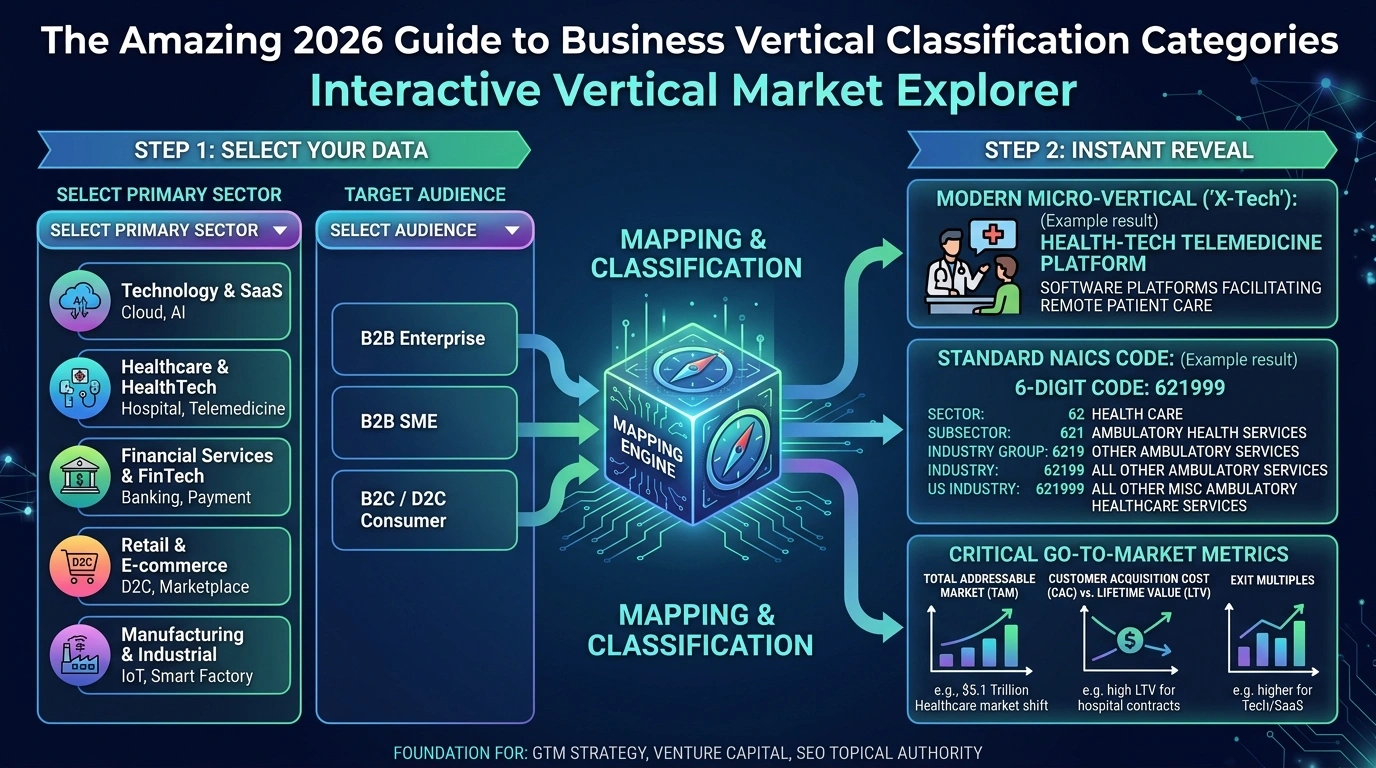
Before diving into the complex government frameworks and investor metrics, use our interactive tool below to explore how different business models map to official classifications and modern micro-verticals.
Interactive Vertical Market Explorer
Select your primary sector and target audience to instantly reveal your modern micro-vertical, standard NAICS code, and critical go-to-market metrics.Show me the visualization
1. What are the Official Business Vertical Classification Categories?
Before startups and marketers coined terms like “SaaS” or “EdTech,” global economists and government agencies needed a way to track the economy. To establish Experience, Expertise, Authoritativeness, and Trustworthiness (EEAT) in any industry, you must understand the “Big Three” official classification systems.
These are not just theoretical; these codes dictate your eligibility for government contracts, SBA loans, and specific tax brackets.
NAICS (North American Industry Classification System)
Adopted in 1997 by the Office of Management and Budget (OMB) to replace the outdated SIC system, NAICS is the standard used by all U.S. federal statistical agencies. Maintained jointly by the U.S. Census Bureau, Canada, and Mexico, it uses a 6-digit hierarchical structure.
- Updates: Every five years (Current standard is 2022; the 2027 revision is underway).
- Best For: U.S. businesses applying for federal contracts, grants, or commercial bank loans.
SIC (Standard Industrial Classification)
Introduced in the 1930s, the SIC system is technically obsolete but remains deeply embedded in legacy financial and legal systems. It relies on a 4-digit code.
- Updates: Last updated in 1987.
- Best For: Filing documents with the Securities and Exchange Commission (SEC), as many legacy compliance frameworks still require SIC codes alongside NAICS.
GICS (Global Industry Classification Standard)
Developed in 1999 by S&P Dow Jones Indices and MSCI, GICS is the global language of finance. Unlike NAICS, which is used by governments, GICS is used by Venture Capital (VC), private equity, and institutional investors to analyze market penetration.
- Structure: 11 Sectors, 25 Industry Groups, 74 Industries, and 163 Sub-Industries.
- Best For: Publicly traded companies, startups building pitch decks, and global market segmentation.
(Note for International Markets: If you are operating in India, you will reference NIC 2008 (National Industrial Classification), which aligns with the global ISIC standard.)
2. Vertical Markets vs. Horizontal Markets
A common pitfall for early-stage companies is confusing a vertical market with a horizontal market. Understanding this distinction defines your entire go-to-market strategy (GTM).
| Feature | Vertical Market | Horizontal Market |
| Focus | Deeply specialized within one specific industry. | Broad, spanning multiple industries. |
| Target Audience | A highly specific niche demographic. | A massive, varied customer base. |
| Example Product | Dental practice management software (HealthTech). | Google Workspace or Microsoft Excel. |
| Competitive Moat | Industry expertise, regulatory compliance. | Network effects, massive scale, brand ubiquity. |
| Pricing Power | High. Expertise commands premium pricing. | Low. Intense price competition based on volume. |
The Strategic Takeaway: It is vastly easier for a new business to dominate a vertical market than a horizontal one. Horizontal markets require hundreds of millions in capital to compete. Vertical markets allow you to build deep topical authority and monopolize a specific customer base.
3. Top 10 Core Business Verticals (With 2026 Projections)
Whether you are a B2B enterprise or a D2C brand, your company likely falls into one of these ten core verticals. Understanding the data driving these sectors is critical for accurate market positioning.
1. Technology & SaaS (Software as a Service)
- What it covers: Cloud infrastructure, cybersecurity, artificial intelligence, and enterprise resource planning (ERP).
- 2026 Market Data: Driven by the explosion of generative AI, global IT spending is projected to surpass $6 trillion in 2026.
- Strategic Advantage: Tech offers the highest gross margins of any vertical. However, software companies must increasingly rely on product-led growth (PLG) as traditional outbound sales channels become saturated.
2. Healthcare & Life Sciences
- What it covers: Hospitals, pharmaceuticals, biotechnology, and medical device manufacturing.
- 2026 Market Data: The U.S. healthcare market is aggressively shifting toward preventative, AI-assisted care, with total spending projected to cross $5.1 trillion.
- Regulatory Compliance: This vertical is governed by strict frameworks like HIPAA and the FDA. High barriers to entry mean less competition for those who can navigate the red tape.
3. Financial Services
- What it covers: Commercial banking, investment management, insurance, and decentralized finance.
- 2026 Market Data: Legacy banking is consolidating, forcing massive investment into digital infrastructure to compete with agile startups.
- Regulatory Compliance: Monitored heavily by the SEC and state banking regulators. Success here requires immense consumer trust and bulletproof data security.
4. Retail and E-Commerce
- What it covers: Brick-and-mortar stores, Direct-to-Consumer (DTC) brands, and global marketplaces.
- 2026 Market Data: E-commerce continues to eat traditional retail, accounting for an ever-growing percentage of total retail sales, driven by mobile shopping and social commerce.
- Strategic Advantage: Low barrier to entry, but requires absolute mastery of logistics, supply chain management, and digital advertising to maintain profitability.
5. Manufacturing and Industrial
- What it covers: Automotive, aerospace, heavy machinery, and consumer packaged goods (CPG).
- 2026 Market Data: “Smart manufacturing” (Industry 4.0) is the dominant trend, with companies investing heavily in IoT sensors and automation to build supply chain resilience.
- Strategic Advantage: High capital expenditures (CapEx) protect incumbents. Once established, manufacturing contracts are incredibly sticky.
6. Real Estate and Construction
- What it covers: Commercial real estate, residential brokerage, REITs (Real Estate Investment Trusts), and urban planning.
- 2026 Market Data: Highly sensitive to central bank interest rates. While commercial office space is evolving, industrial real estate (data centers, fulfillment warehouses) is seeing historic demand.
- Strategic Advantage: Tangible asset backing.
7. Education
- What it covers: K-12, higher education, corporate learning and development (L&D), and professional certification.
- 2026 Market Data: The global shift toward hybrid learning and continuous upskilling has permanently altered this landscape, driving the value of the education market into the hundreds of billions.
- Strategic Advantage: Mission-driven customer loyalty and long-term recurring revenue models (especially in corporate L&D).
8. Energy and Utilities
- What it covers: Oil and gas, renewable energy (solar, wind), battery storage, and grid management.
- 2026 Market Data: A massive structural shift is underway as global capital rotates from fossil fuels into cleantech and sustainable infrastructure.
- Strategic Advantage: Government subsidies and long-term contracts guarantee revenue, though the vertical is highly regulated and capital-intensive.
9. Transportation and Logistics
- What it covers: Freight forwarding, last-mile delivery, aviation, and supply chain software.
- 2026 Market Data: Margins remain tight, but optimization algorithms and automated dispatching are creating highly profitable sub-niches within the broader logistics space.
- Strategic Advantage: Essential infrastructure. The economy stops without it, ensuring permanent, baseline demand.
10. Media, Entertainment, and Hospitality
- What it covers: Streaming platforms, gaming, hotels, restaurants, and live events.
- 2026 Market Data: Driven entirely by consumer sentiment. Advertising revenues and subscription models are being heavily disrupted by the “Creator Economy.”
- Strategic Advantage: High potential for virality and brand loyalty, though it remains the most trend-dependent of all business verticals.
4. The Rise of Micro-Verticals and “X-Tech”
Traditional classifications like NAICS are slow to update. In 2026, the most lucrative market segmentation occurs at the Micro-Vertical level. By combining a traditional industry with modern technology, startups create new, highly targeted categories often referred to as “X-Tech.”
- FinTech (Financial Technology): Companies like Stripe or Plaid. They operate in finance but function like SaaS companies.
- HealthTech / Telemedicine: Software platforms that facilitate remote patient care, circumventing traditional hospital infrastructure.
- PropTech (Property Technology): Platforms streamlining real estate transactions, property management, or smart-home integration.
- EdTech (Educational Technology): E-learning platforms replacing traditional classroom models or providing highly specialized corporate training.
- AgriTech (Agricultural Technology): Using drones, IoT sensors, and data analytics to optimize crop yields and supply chains.
- MarTech (Marketing Technology): The sprawling ecosystem of software used by digital marketers to automate campaigns, track users, and analyze data.
Why this matters: When a founder tells an investor, “We are a real estate company,” the investor assumes slow growth and heavy physical assets. When the founder says, “We are a PropTech SaaS platform,” the investor assumes high margins, recurring revenue, and rapid scalability.
5. Strategic Value: Why Startups and VCs Care About Verticals
If you are a startup founder, your business vertical classification directly dictates your valuation. Venture Capital (VC) firms do not evaluate companies in a vacuum; they benchmark you against your specific vertical.
Here is why accurate vertical positioning is non-negotiable for fundraising:
1. Total Addressable Market (TAM)
TAM is the total revenue opportunity available if your product achieved 100% market share. VCs require a massive TAM to justify investment. A horizontal tool might have a larger theoretical TAM, but a specialized vertical market SaaS product often has a much more realistic and capturable TAM.
2. Customer Acquisition Cost (CAC) vs. Lifetime Value (LTV)
Different verticals have drastically different acceptable metrics.
- In D2C Retail, a CAC of $50 might be terrible if the LTV is only $60.
- In Enterprise B2B HealthTech, a CAC of $10,000 is excellent if the LTV of a hospital contract is $500,000.Knowing your vertical allows you to prove your unit economics are healthy compared to your peers.
3. Exit Multiples
When a company is acquired or goes public, its valuation is often based on a multiple of its revenue or EBITDA. These multiples vary wildly by vertical. A traditional manufacturing firm might trade at 2x revenue, while a high-growth FinTech or SaaS company might trade at 10x or 15x revenue. Categorizing yourself correctly ensures you are valued on the right scale.
6. Digital Marketing & SEO: Building Topical Authority
For digital marketers and SEO professionals, business vertical classification categories are the secret weapon for dominating search engines. In the era of AI-driven search, Google no longer rewards websites that talk about “a little bit of everything.”
Google rewards Topical Authority.
The SEO Strategy for Verticals
If you are a marketing agency, you will never rank for the keyword “marketing services.” The horizontal market is too saturated.
However, if you classify your business into a micro-vertical and optimize for “MarTech SEO for B2B SaaS Startups,” you drastically reduce keyword difficulty.
- Keyword Clustering: By focusing on a vertical, you can build semantic clusters of content. A HealthTech company can write exhaustively about HIPAA compliance, telemedicine billing, and patient data security. This signals deep expertise to search algorithms.
- Lower CPC (Cost-Per-Click): Broad horizontal keywords are incredibly expensive on Google Ads. Vertical-specific, long-tail keywords convert at a much higher rate for a fraction of the cost.
- Enhanced EEAT: Google specifically looks for trust signals in YMYL (Your Money or Your Life) verticals like finance and healthcare. Clear vertical classification helps you structure your site to feature author credentials, compliance badges, and peer-reviewed data relevant to that specific field.
7. How to Find Your Business Vertical (5-Step Guide)
If you are struggling to define your exact vertical, use this actionable, five-step framework:
Step 1: Follow the Revenue. Look at your current P&L. Which specific industry generates 60% or more of your revenue? That is your primary vertical. Do not classify yourself based on the product you wish you were selling; classify based on what is actually making money.
Step 2: Define the End User. Are you B2B (selling to other businesses) or B2C/D2C (selling directly to consumers)? This instantly cuts your potential classifications in half.
Step 3: Identify the Regulatory Burden. What rules govern your product? If you have to adhere to GDPR for data, SEC rules for payments, or FDA rules for consumables, your vertical is already chosen for you.
Step 4: Find Your NAICS Code. Go to the official US Census Bureau website (or your local equivalent) and search their database using your primary product keyword. Finding your exact 6-digit code will provide ultimate clarity.
Step 5: Test the “Elevator Pitch.”
Can your sales team explain your vertical positioning in one sentence without using the word “and”?
- Bad: “We provide software for retail, and logistics, and finance.” (Horizontal, unfocused).
- Good: “We provide cybersecurity software exclusively for regional banking institutions.” (A perfect, highly targeted FinTech vertical).
8. Frequently Asked Questions
What are the 7 verticals of business?
While frameworks vary, the 7 most universally recognized verticals in B2B markets are:
1. Healthcare,
2. Financial Services,
3. Retail & E-commerce,
4. Manufacturing & Industrial,
5. Education,
6. Real Estate & Construction, and
7. Technology & IT.
What are the 4 main types of business?
This refers to how a business generates revenue, rather than its industry. The 4 main types are:
1. Service Businesses (providing expertise),
2. Merchandising/Retail (buying and selling goods),
3. Manufacturing (creating goods from raw materials), and
4. Hybrid Businesses (combining the previous models, like a restaurant).
What are the 4 business sectors?
Sectors are macroeconomic categories used by economists:
1. Primary Sector (extraction of raw materials like farming/mining),
2. Secondary Sector (manufacturing and production),
3. Tertiary Sector (services and retail), and
4. Quaternary Sector (knowledge, IT, and research).
Can a startup operate in multiple verticals?
While massive conglomerates (like Amazon) operate in multiple verticals, startups should avoid this. Operating in multiple verticals dilutes your marketing budget, confuses your product roadmap, and makes it difficult to establish the topical authority and targeted GTM strategy required to win early-stage market share. Focus on one vertical, dominate it, and expand later.