
Can Automation Really Handle Angry or Frustrated Customers?
Picture this: A customer who’s been waiting three weeks for a delayed order opens your chatbot. They’re furious. They type in all caps:
“WHERE IS MY ORDER?! THIS IS ABSOLUTELY UNACCEPTABLE!”
Your automated chatbot cheerfully responds: “Hi there! 😊 How can I help you today?”
The customer explodes. Within minutes, they’re posting a scathing review on every platform imaginable.
This is the nightmare scenario that makes business owners hesitate about customer service automation.
And honestly? The fear is valid.
But here’s the nuanced truth that might surprise you: Automation CAN handle frustrated customers—but only when designed correctly, with immediate human escalation protocols, and never as the sole solution.
According to research by Gartner, 86% of customers expect companies to deliver personalized interactions, and 76% get frustrated when this doesn’t happen. Yet the same research shows that smart automation with sentiment detection and rapid escalation actually improves satisfaction for frustrated customers compared to long email wait times.
The key isn’t whether automation can handle angry customers. It’s how you design your system to recognize frustration instantly and respond appropriately.
The Honest Answer: What Automation Can and Can’t Do
Let’s start with brutal honesty about capabilities and limitations:
What Automation CAN Do for Frustrated Customers
✓ Provide immediate acknowledgment (vs. “we’ll respond in 24-48 hours”)
✓ Detect frustration through sentiment analysis (recognizing angry language, caps, profanity)
✓ Instantly escalate to human agents (faster than any manual system)
✓ Gather context while customer vents (so human agent has full background)
✓ Offer immediate solutions (if problem is solvable automatically—refund, replacement, tracking info)
✓ Maintain calm, professional tone (doesn’t take offense, get defensive, or escalate emotionally)
✓ Document everything (perfect record for quality control and pattern recognition)
What Automation CANNOT Do
✗ Provide genuine empathy (can express scripted sympathy but not authentic human understanding)
✗ Make judgment calls (exceptions, unique situations, “I’ll make this right” decisions)
✗ Read between the lines (subtext, cultural nuances, what’s really bothering someone)
✗ Repair emotional damage (when customer needs to feel heard by a real person)
✗ Handle abuse gracefully (prolonged harassment requires human judgment and boundaries)
✗ Build trust after it’s broken (relationship repair is inherently human)
✗ Navigate truly complex situations (legal issues, safety concerns, unique circumstances)
Capability Comparison: Automation vs. Human for Angry Customers
| Situation | Automation Effectiveness | Human Effectiveness | Best Approach |
| Simple issue + Frustration (late delivery, wrong item) | High (can solve immediately) | High (but slower) | Bot solves, human available |
| Complex issue + Anger (billing dispute, service failure) | Low (can’t judge/decide) | Very High | Immediate escalation |
| Customer demands to speak to person | N/A (honor request) | High | Instant human handoff |
| Profanity but solvable issue | Medium (can solve but escalate) | High | Bot offers solution + human option |
| Multiple failed interactions | Very Low (trust broken) | Very High | Human only |
| Threats or abuse | Low (needs human judgment) | High (with protocols) | Immediate escalation + documentation |
| Emotional distress beyond product | Very Low (needs empathy) | Very High | Human only |
How Smart Automation Detects Frustration
Modern customer service chatbots use multiple signals to identify angry or frustrated customers:
Sentiment Analysis Triggers
Language-based detection:
- All caps: “THIS IS RIDICULOUS”
- Profanity: “This f***ing product doesn’t work”
- Negative keywords: “terrible,” “awful,” “worst,” “horrible,” “useless”
- Demanding language: “I DEMAND,” “I WANT TO SPEAK TO,” “UNACCEPTABLE”
- Repetition: “Why won’t you help me? Why won’t you help me?”
Pattern-based detection:
- Multiple exclamation points: “Fix this now!!!”
- Rapid-fire short messages (sign of agitation)
- Increasing message length (escalating explanation/venting)
- Explicit frustration statements: “I’m extremely frustrated”
Behavioral triggers:
- Returning after previous unresolved interaction
- Asking same question 3+ times (bot not understanding)
- Long gaps followed by aggressive response (patience exhausted)
- Requesting human multiple times
Platform-specific indicators:
- Typing, deleting, typing again (visible frustration on some platforms)
- Very fast typing (emotional intensity)
- Messages sent at odd hours (problem keeping them up)
The Smart Escalation System (How It Should Work)
Here’s the framework that actually works for frustrated customers:
Tier 1: Immediate Auto-Response (First 10 Seconds)
When frustration detected, bot immediately:
Acknowledges emotion explicitly: “I can see you’re frustrated, and I completely understand. Let me help resolve this right away.”
NOT generic cheerfulness: “Thanks for reaching out! 😊” ← This enrages angry customers
Sets clear expectations: “I’m going to connect you with someone who can help immediately, OR I can [solve specific issue] right now if you prefer.”
Gives control back: “Would you like to:
- Speak with our team now (2-minute wait)
- Have me try to resolve this immediately
- Schedule a call for [specific time]”
Tier 2: Solution Attempt (10-30 Seconds)
If customer chooses automated solution, bot:
States problem understanding: “It looks like your order #12345 was supposed to arrive on Tuesday and hasn’t. Is that correct?”
Offers concrete action: “I can:
- Issue a full refund right now
- Send a replacement with overnight shipping
- Apply a 50% credit to your account Which would you prefer?”
If customer accepts: Problem solved, frustration diffused
If customer refuses or issue is complex: Immediate escalation
Tier 3: Human Handoff (30-60 Seconds)
Critical elements of effective handoff for angry customers:
Emotional acknowledgment: “I want to make sure you get the best help possible. Connecting you with [Name] from our resolution team right now.”
Context transfer: Agent sees:
- Full conversation history
- Sentiment analysis: “High frustration detected”
- Customer value: “Lifetime customer, 15 orders, $2,340 spent”
- Issue category: “Delayed shipment, 3 weeks late”
- Previous interactions: “Contacted twice before”
No repetition required: Agent opens with: “I can see your order is 3 weeks late and you’ve contacted us before. I’m going to fix this right now. Here’s what I’m doing…”
Not: “Hi, how can I help you today?”
Real-World Case Studies
Success Story: TechPro Electronics
The Challenge: Customer received defective laptop, third replacement also defective, beyond frustrated
Automation approach:
Bot detected:
- Profanity in initial message
- Customer typed “THIRD TIME”
- Previous interaction notes showed unresolved issues
- Sentiment score: 92% negative
Bot response (15 seconds): “I see this is your third defective unit, and that’s completely unacceptable. I’m connecting you to Sarah, our senior resolution specialist, immediately. She has authority to make this right.”
Human takeover: Sarah saw full context, immediately offered:
- Full refund + 25% credit toward any future purchase
- Overnight shipping for competitor’s equivalent model
- Personal follow-up call once item arrived
Outcome:
- Customer calmed within 2 minutes
- Accepted solution
- Posted positive review about recovery: “They finally took me seriously and fixed it immediately”
Key lesson: Bot recognized severity instantly and escalated to empowered human with context
Failure Story: BudgetMart (What NOT to Do)
The Challenge: Customer charged twice for same order
Bad automation approach:
Bot response: “I’m sorry you’re experiencing issues! 😊 Can you tell me your order number?”
Customer (already furious, now more so): “I ALREADY GAVE YOU MY ORDER NUMBER! YOU CHARGED ME TWICE!”
Bot (didn’t detect anger): “Thank you! Let me look that up for you!”
Bot (after ‘checking’): “I don’t see any issues with order #12345. Is there anything else I can help with?”
Customer: “ARE YOU KIDDING ME?! CHECK MY BANK STATEMENT!”
Bot: “I understand you’re frustrated! Have you tried checking your email confirmation?”
Result:
- Customer requested chargeback
- Left scathing reviews on 3 platforms
- Canceled account
- Told story on social media (went viral)
- Company lost customer + reputation damage
What should have happened:
- First message with caps + “CHARGED TWICE” → Instant human escalation
- No cheerful emojis to angry customer
- No circular conversation loops
- Empowered agent with refund authority immediately
Sentiment Detection Accuracy
| Customer Message | Sentiment Score | Recommended Action | Why |
| “Hi, when will my order arrive?” | Neutral (0%) | Bot handles | Simple question, no emotion |
| “My order is late. When will it arrive?” | Slight negative (15%) | Bot handles, monitor | Factual concern, not emotional |
| “This is the third time I’ve asked. When will it arrive?!” | Moderate negative (45%) | Bot solves immediately OR escalate | Frustration building |
| “WHERE IS MY ORDER?! I’ve been waiting for THREE WEEKS!” | High negative (75%) | Immediate escalation | Clear anger |
| “This is absolutely ridiculous. I’m never ordering again.” | Very high negative (88%) | Priority escalation + retention specialist | Customer at risk of churning |
| “F*** this. Worst company ever. Demanding refund NOW.” | Extreme negative (95%) | Instant senior agent + empowered to resolve | Crisis mode |
Best Practices for Automation with Angry Customers
1. Set Ultra-Low Escalation Thresholds
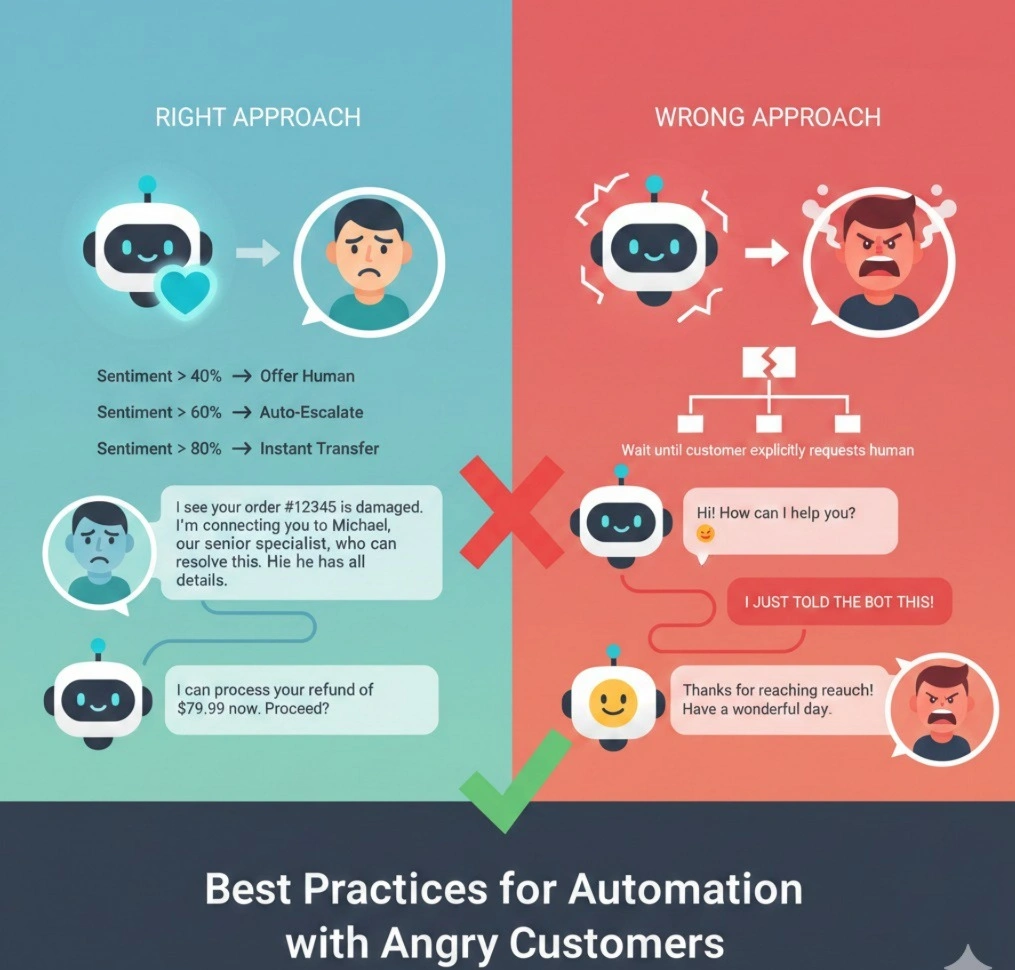
Wrong approach: Wait until customer explicitly requests human
Right approach: Escalate at first sign of frustration
Implementation:
- Sentiment score > 40% → Offer human immediately
- Sentiment score > 60% → Auto-escalate (ask but assume yes)
- Sentiment score > 80% → Instant transfer, no questions
2. Never Make Them Repeat Themselves
This destroys trust faster than anything:
Customer to bot: “My order #12345 is damaged”
Bot: “I’m connecting you with my team”
Human: “Hi! What’s your order number and what’s the issue?”
Customer (now furious): “I JUST TOLD THE BOT THIS!”
Fix: Ensure agents see complete conversation + context instantly
3. Drop the Cheerful Act Immediately
Wrong responses to angry customers:
- “Thanks for reaching out! 😊”
- “I’m happy to help!”
- “Have a wonderful day!”
Right responses:
- “I understand this is frustrating.”
- “Let me fix this right away.”
- “I’m going to make this right.”
Tone matters: Match seriousness to situation
4. Empower Bots to Offer Solutions (Not Just Route)
Weak approach: Customer: “I want a refund!”
Bot: “Let me connect you to someone who can help”
Strong approach: Customer: “I want a refund!”
Bot: “I can process your refund right now. I’ll credit $79.99 back to your original payment method within 3-5 business days. Should I proceed?”
Why it works: Immediate solution often diffuses anger
5. Explain What You’re Doing and Why
Bad handoff: “Connecting you to an agent. Please wait.”
Good handoff: “I can see this needs someone with authority to make exceptions. I’m connecting you to Michael, our senior support specialist, who can resolve this. He’ll have all the details, so you won’t need to explain again. Connecting now…”
Why: Reduces anxiety, shows you understand severity
When Automation Should NEVER Handle Angry Customers
Certain situations require immediate human intervention with zero automation:
Absolute Human-Only Scenarios
Legal issues:
- Threats of lawsuits
- Regulatory complaints
- Data breaches or privacy concerns
- Injury claims
Safety concerns:
- Product causing harm
- Health/medical implications
- Child safety issues
- Dangerous product defects
Severe emotional distress:
- Customer crying or expressing extreme distress
- Mental health crisis indicators
- Personal tragedy mentioned
- Abuse or harassment disclosure
High-value accounts:
- Enterprise clients
- VIP/loyalty program members
- Accounts > $X lifetime value
- At-risk of significant churn
Pattern of failed automated interactions:
- 3+ previous bot conversations didn’t resolve
- Customer explicitly states “I’ve tried the bot”
- Returning angry about AI/automation itself
- Complex multi-issue problem
Viral risk situations:
- Influencer or public figure
- Issue already on social media
- Journalist or media inquiry
- Potential PR crisis
Implementation Checklist: Setting Up Frustration Handling
Week 1: Sentiment Detection
☐ Enable sentiment analysis in your chatbot platform (most have built-in)
☐ Set escalation thresholds:
- 40%+ negative → Offer human option
- 60%+ negative → Auto-escalate
- 80%+ negative → Priority queue
☐ Add keyword triggers:
- Profanity → Escalate
- “TALK TO A HUMAN” → Instant transfer
- “MANAGER” → Senior agent
☐ Test detection accuracy:
- Send 20 test messages (neutral to very angry)
- Verify system categorizes correctly
Week 2: Escalation Protocols
☐ Create urgency levels:
- Standard: Normal queue
- Elevated: Jump queue
- Critical: Immediate senior agent
☐ Configure context transfer:
- Full conversation history visible to agent
- Sentiment score displayed
- Customer value/history shown
- Issue auto-categorized
☐ Set up agent notifications:
- Desktop alerts for high-priority escalations
- Mobile push for critical
- Different ringtones by urgency
☐ Establish response time standards:
- Elevated: Under 2 minutes
- Critical: Under 30 seconds
Week 3: Response Templates
☐ Write empathetic acknowledgments:
- “I can see this is frustrating…”
- “This is not acceptable, and I’m going to help…”
- “I understand why you’re upset…”
☐ Create solution-first scripts:
- Immediate refund offers
- Replacement options
- Compensation authorization levels
☐ Develop human handoff language:
- Avoid “Let me connect you to someone who can help” (implies bot can’t)
- Use “I want to get you the best resolution, so I’m connecting you with [specific role]”
☐ Remove all cheerful/casual language from frustrated customer paths
Week 4: Testing and Training
☐ Role-play angry customer scenarios with team
☐ Test escalation speed:
- Angry message sent → How long until human responds?
- Target: Under 60 seconds for critical
☐ Verify agents see full context before responding
☐ Document edge cases and how to handle
☐ Set up monitoring:
- Track: Sentiment detection accuracy
- Measure: Escalation resolution rate
- Monitor: Angry customer satisfaction post-resolution
Advanced Strategies for Difficult Customers
Proactive Frustration Prevention
Before they get angry:
Order delayed? Bot reaches out first: “Hi Sarah, I wanted to let you know your order is running 2 days late due to weather. I’ve already applied a 15% credit to your account. Would you like to keep the order or cancel with full refund?”
Payment issue detected? Immediate notification: “Your payment didn’t process. No worries—I’ve saved your cart. Would you like to try a different payment method, or should I hold the items for 48 hours?”
Why it works: Addressing problems before customer discovers them prevents frustration
The Apology That Actually Works
Weak bot apology: “Sorry for the inconvenience!”
Strong bot apology (when appropriate): “This is not the experience you deserve. I’m going to fix this immediately. Here’s what I’m doing: [specific action].”
Key difference: Action-oriented, specific, acknowledges problem severity
Smart Compensation Automation
Bot authorized to offer (with limits):
- Discount codes up to $X
- Free shipping on next order
- Account credits
- Small refunds without manager approval
Requires human approval:
- Full refunds over $X
- Repeated compensation to same customer
- Exceptions to policy
- Custom solutions
Why: Empowered bots resolve faster, preventing escalation
Measuring Success with Frustrated Customers
Key Metrics to Track
| Metric | What It Measures | Target Benchmark |
| Escalation speed | Time from frustration detection to human response | Under 60 seconds |
| Post-resolution satisfaction | Rating after angry customer interaction | 4+ out of 5 |
| De-escalation rate | % of angry customers who calm down | 70%+ |
| Repeat frustration | Same customer angry again within 30 days | Under 10% |
| Sentiment improvement | Negative to neutral/positive shift | 60%+ |
| First contact resolution (angry) | % resolved in one interaction | 75%+ |
| Agent stress levels | Team feedback on difficult interactions | Low (system helps them) |
What Customers Actually Want When They’re Angry
Research shows frustrated customers want (in order):
1. Acknowledgment (74% priority)
- “I see this is frustrating” beats “Let me help!” by 3:1
2. Immediate action (71% priority)
- “I’m refunding you now” beats “I’ll look into this” by 5:1
3. Accountability (68% priority)
- “This is our mistake” beats “I’m sorry you feel that way”
4. Prevention commitment (52% priority)
- “We’re fixing the process that caused this” beats “Sorry”
5. Human connection (47% priority – but jumps to 89% if other needs aren’t met)
- Sometimes they need a person, but not if bot solves it immediately
Key insight: Most angry customers don’t care if bot or human helps them—they care about FAST, EFFECTIVE solutions with genuine acknowledgment.
The Hybrid Approach That Works Best
The winning formula isn’t bot OR human—it’s bot AND human working together:
Optimal Flow for Angry Customers
Stage 1: Bot Detection (5 seconds)
- Sentiment analysis identifies anger
- Context gathered automatically
- Problem categorized
Stage 2: Bot Triage (10-15 seconds)
- If simple + solvable: Bot offers immediate solution
- If complex or customer requests human: Instant escalation
Stage 3: Human Resolution (1-5 minutes)
- Agent has full context (no repetition needed)
- Empowered to resolve with flexibility
- Bot assists agent with information lookup
Stage 4: Bot Follow-Up (24 hours later)
- “How did we do resolving your issue?”
- Captures feedback
- Flags if still unsatisfied for human follow-up
Result: Speed of automation + empathy of humans = best of both worlds
Conclusion: Yes, But Only With Smart Design
Can automation really handle angry or frustrated customers?
The complete answer:
Simple automation alone? No. It will make things worse.
Smart automation with instant human escalation? Absolutely yes—and often better than human-only systems.
Why?
Speed matters: Automated frustration detection and instant escalation is FASTER than:
- Waiting in phone queue for 20 minutes
- Waiting 24 hours for email response
- Getting bounced between departments
Context matters: Bot gathering information while escalating means human agent is prepared, not starting from scratch.
Availability matters: Bot available 24/7 to detect and escalate beats business-hours-only phone lines.
The key: Don’t ask “bot or human?” Ask “how can bot and human collaborate to help angry customers fastest?”
Your Implementation Action Plan
This week:
- Enable sentiment analysis in your chatbot platform
- Set up instant escalation for high frustration (60%+ negative sentiment)
- Remove cheerful language from escalation paths
- Test with 10 simulated angry customer scenarios
Next week:
- Train team on receiving escalated angry customers with context
- Set response time targets (under 60 seconds for critical)
- Document empowered resolution options (refunds, credits, exceptions)
- Establish monitoring system for angry customer outcomes
Month 1:
- Review first 50 angry customer interactions
- Measure escalation speed and resolution rates
- Survey angry customers post-resolution
- Refine based on actual data
Remember: The goal isn’t replacing human empathy with robots. It’s using automation to detect problems faster, gather context efficiently, and connect frustrated customers with empowered humans who can actually fix things—all in under 60 seconds.
Your angry customers don’t care about your technology stack. They care about being heard, acknowledged, and helped—fast.
Automation done right delivers all three.
Additional Resources: